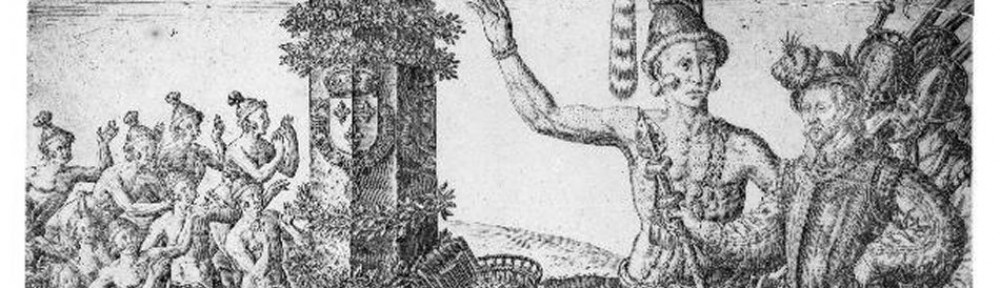
Alonso Gregorio de Escobedo, O.F.M. La Florida [ca. 1590-1610].
Please do not reproduce without permission. The following is a draft translation, prepared by Thomas Hallock, in support of The Epic of Florida: Selected Poems by Juan de Castellanos, Bartolomé de Flores, and Alonso Gregorio de Escobedo (Pennsylvania State University Press, 2026).
Canto 30. The enemy took off towards the Spanish armada, which had taken safe harbor, and the French landed on the coast, where General Menendez killed two thousand Frenchmen. He brought to court three chief, who became Christians.
What purpose does an earthly treasure serve
the thief, when he holds in his possession
a store that is, by Divine Law condemned,
that is without any restitution?
His soul will pay with the eternal fires,
burning for all time in the pits of Hell,
because God will never forgive the sins
such as those committed by Jean Ribault.
If Ribault had held to the divine law,
had he not occupied these western lands
and stolen gold, as he was so inclined,
Jesus still would have protected his soul.
Lack of principal ruined him. He cared
naught for the harm he did to the Indians,
people who had their own furrows to plow.
But because this Frenchman was a pirate,
and one who was a thief by trade, he put
himself in the position where he could
do the greatest harm to our own people.
Ribault was one who lived in contrary
to all good, and with notorious vice
and with the absence of God in his life,
he lost the clear and true heavenly light.
After our nobles, sailing from the East,
accomplished their immortal deeds, stripping
and dispossessing the French of their fort,
it remained for them to claim the treasures
that were heroically won for the King;
the opulent regal banners were hung
from the high points of the castle and men
were stationed there to keep the fort secure.
Meanwhile the others went back down the trail,
guided by the Indian who had been paid,
but who also had proven himself to
be their friend through this honorable task.
and who had been paid his noble work
And after crossing the great river of Saint
Augustine,[1] they were ordered to split up,
to see if the winds had fatefully blown
onto the coast the men who stole from them.
Our people stomped their feet onto dry ground
and marched along the coast, until they reached
a post where the river surrounded them
and flowed into salt water. God had left
the French here, for the Spanish to wage war;
Jean Ribault would pay for what he had done
losing not only his strong armada
but also his precious pearl of freedom.
General Menéndez was overseeing
his army from the beach on the western
shore, and when he saw the French wandering
along the coast, he corrected his course,
bravely and loudly shouting, “I command
you to shift direction. Make a forced march
from this crescent beach to the higher hill
to establish a secure position.
Walk quickly, keeping under the cover
of the undergrowth, and with God in Heaven
as my witness, we shall soon see whether
we have the necessary strength or not;
General Ribault is sure feel distress
when he realizes our courage, and when
he catches sight of our country’s flags
planted here and fluttering in the wind.
I trust in God that my preparations
and keen-edged strategy will be enough
to snap the neck of the arrogant French
and wipe the fleur-de-lis from their banners.
With the eastern, Levantine winds having
tamed these men of their arrogance, for sure
I will win the victory, and we will
give to God all our honor and glory.
And may this enemy, from his position
along the shoreline now pay for his sins,
to be broken beyond recognition
never returning to the field of battle.
Here he stands to lose what he has stolen
from the Spanish. Everything. First to last.
And here, in God I trust, under your strong
arm and my own, he will give up his life.”
Oh, fickle fortune! Who could have predicted
that three days before today, the fury
of gale-force winds would have swept a mighty
armada to the shore, splintering their ships.
Oh, you vain Frenchman! Did you consider
how your infernal and unbridled greed,
how your envy and animosity,
how your sins, would be punished by this storm?
Jean Ribault was in the field of battle
drying out his muskets and gunpowder,
when Menéndez, the Spanish general arrived,
He thought about Ribault’s ruin and fall.
Now our people were already marching
into battle, flags wind in the wind;
Ribault expressed his disgust at the sight,
although he remained strong and resolute.
As Menéndez boldly addressed Ribault:
“Although you are my enemy, I feel
sympathy in my soul, for with your people
you are lost on this beach without shelter.
Be valiant, and show gratitude to me,
bow yourself humbly in obedience
and I will treat you as I would a friend,
by providing you passage back to France.
“If I regret see you now defeated,
it would be because of your surrender,
which does not let me claim victory;
with no vanquishing I claim no glory.
I well remember how I promised that
you would be given passage, allowing
you and your soldiers to return to France
as long as you remained obedient.”
Jean Ribault trusted the Asturian,
and not seeing any change in him,
this promise having come from a Christian,
Ribault took Menéndez at his word.
With no other options, besides, and death
being this close, he recognized that
surrender as his best and only chance —
with no other recourse, he played his hand.
Everything was taken care of for him:
he was to be given food and passage
to take him out of Florida and back
to France, to appear before the King.
This regal clemency satisfied him.
Ribault and his people had been given
a new day; failing to hold up his end,
however, the traitor was put to death.
The general to the French king promised
peace with the Spanish. But not after taking
ten steps from him did the Frenchman rebel,
raising his sharp-edged sword with his right hand,
believing with tremendous arrogance
that his surrender to the Asturian
Menéndez was not needed, not with
the soldiers in his army watching on.
Swinging like a boom around the mast,[2]
Ribault turned, trying to kill Menéndez,
but Menéndez was aware of the French
around him and had remained vigilant.
Such things pass with our nation, unique and rare:
in the face of opponents, yes, we awake,
showing our valor, on this occasion,
and taking the broad sword in our right hand.
The command was given to enter battle,
and even while the enemy had more troops,
our courageous forces broke the line,
dissolving their defense with few men;
it was hard to tell who was on which side,
but death was brought to the one who had been
previously left to live, a traitorous
criminal and thug, now rightly murdered.
The waters of the Occident, or West,
were soon stained crimson with the human blood
of the many French who died in battle,
and a few of our own Castilian troops.
Wielding a two-handed broadsword in battle
the courageous and competent General,
Pedro Menéndez, achieved such feats that
ferocious Mars himself would have envied.
In the end the French surrendered to our men,
and had their hands bound up. Stripped of their swords,
which were useless to them, they cried and moaned,
clearly and distinctly understanding
that they would never return to their home,
that they were now left to the disposal
of the more powerful Spanish general,
who had every right to show his fury.
Following the orders of Menéndez,
the prisoners were forced to start walking
in groups of six, with two experienced
Spanish soldiers marching along the side.
“Keep them closely guarded in the middle,”
he said, “allowing for no disorder.
I will go ahead to our armada,
where they will be given their last supper.”
Menéndez then called upon a captain
who was as brave as he, someone known as
Vincent el animoso,[3] the brave one —
known for his selfless service to the King.
Menéndez granted Vincent the honorable
duty of executing right justice
to those who had stolen from travelers
and who rightly deserved a painful death.
Choosing a captain for accompaniment,
Menéndez proceeded ahead, speaking
with the great warrior, Jean Ribault,
who at that moment had lost his power.
And Menéndez said to his two men: “Keep
everything quiet and encourage them;
I will draw a line on the beach, and at
that place, Jean Ribault shall be put to death.
“Be sure that my command is known by all,
and because our people know the story.
Show great care and display due diligence.
The braggart Frenchmen and his troops shall pay
for their unrestrained insolence with their lives:
I am outraged, and at this place, I will
deliver to them the death they deserve.
With an azcona, or small lance, in his
right hand, our Asturian Menéndez
proceeded to draw a line in the sand,
proclaiming and delivering a sentence
of death. The French general watched and noted
what the brave Castilian, now his captor,
was doing, and noted that the promised
actions were now to be executed.
“Señor Ribault, mark this line in the sand:
I have been ordered to kill you, or face
punishment myself for not doing so
by a firm, powerful, unyielding hand.
This sentence has been ordered against you
by an unlucky turn of fate, and now
you have no appeal left to make on earth,
you can only plead to God in the sky.
When Ribault considered the Spaniard’s
proposal, his face lost all its color;
fear has this way of transforming even
the most skillful, brave and courageous man.
And being himself a man of honor,
Vincente, the man chosen for the task,
executed the punishment, with such
effect as one would ordinarily expect.
From the dagger dug into his strong chest,
the blood ran along the beach, past the line
that Menéndez had drawn in the dry sand,
leaving the rabid Ribault by the sea.
And the Castilians took satisfaction
as a bitter and painful end was brought,
as death was delivered to the soldiers
who fought as well under Ribault’s command.
The Spanish claimed victory over the French,
who were stripped of their navy, then their
breath, and the memory will live forever —
these famous events that I here recount,
to God we now sing the honor and praise,
for sending winds from the Levante, or East,
so our people could cleanse these western lands.
The General remained, staying to patrol
la Florida, where the wretched people
lived without clothing, naked, dressed only
in the contempt of God, the First Mover;
they were idle not taking on the
They were bereft, not living the Good Life,
but through the Spanish nation’s victory,
they took the yoke of the Roman shepherd.
God brought to them Topique, a noble chief
with great wealth, a friend from western lands,
and Topique brought two other chiefs with him–
these three all proving to be welcoming.
In Spain they were given splendid shelter
and favor from Philip, the Austrian,
King of Spain and the New World, one without
any second, noble, discreet and wise.
In satisfaction and peace these Indians
received the divine rite of baptism,
given by the priests of our sainted church
and planting the seeds of faith in their souls.
There was no lack of courteous gentlemen
who came to see what our omnipotent
God had sown in the fertile, remote
fields of the Western or Occidental lands.
Menéndez carried an official
decree that was signed and sealed, the red wax
pressed with the cross of Christ, designating
him as the marques of all Florida.
He had set out upon this new journey
with this blessing from the enlightened king,
an instrument that served not only here
on earth but above, as well, in heaven.
As soon as the brave Asturian
Menéndez touched his feet upon the sand,
he brought a new day to la Florida;
the famed army of Christian soldiers
had fastened the hard bridle, reign and bit
to the seditious Indians, who were
before unconquered and who from their coasts,
would treasonously steal from our fleets.
And so upon the King’s command they made
a fortification in Florida.
Given how the French pirates had come there,
and how the Spanish quickly kicked them out,
three hundred men would now be stationed there,
to exercise the bravery of Mars–
Castilian soldiers who were paid to stay,
administered by Mexican accounts.
The Christian chiefs were also given leave
to return to their own villages
and bring to the once blind people the light
of faith that the chiefs themselves had received.
Throughout this land, they remained at peace,
serving under God, their holy North star–
until a Castilian man was killed,
ambassador to the Christian general.
When the bold Menéndez first heard the news,
he ordered the three insolent Indians
to be brought to trial, so they would receive
the punishment they deserved. And so
the living would also receive the chance
to see for themselves the consequences
of depriving a Spaniard of his life,
of killing a Castilian in cold blood.
It fell upon the Lusitanian Vicente Gonzalez, to carry out
the command: the Portuguese captain should
raise his sword with a strong and dexterous hand,
to end the life of the three Indians
and so he moved beyond the Spanish line,
boarding one of the navy’s light vessels,
with fifteen soldiers in the boat’s galley
rowing the oars towards the Indian’s side.
With haste the soldiers launched their boat into
the thrashing gulf,[4] filed with desire to punish
anyone who had the insane desire
of claiming a trophy of war from them.
The Spaniards set out against an infamous
group of people, a king who took justice
into his own hands, and who would himself
pick a fight with the ferocious Mars.
Thirty-five of our most noblest men, who
had sailed from the east lands, boarded
boarded our Castilian boat, commanded
by a courageous and righteous captain
with a Lusitanian lineage and home —
these valiant young soldiers, these brave people
served as defenders of our Christian faith
and each of them swore to lose their own life
in challenging the murderous Indian.
And as the King’s boat approached the island
of Guale, two thousand Indians emerged
from the earth, showing their full strength in war
and exercising their savage power;
but our captain displayed his great brio
and banished all fears within his squadron,
saying to his men: “be not afraid, brave
soldiers, seeing these infidels stirred up.”
Several villages launched their resistance:
the Spanish infantry fired against them
holding up against an enemy
who was showering them with arrows.
As was their usual custom, the faithful
killed a thousand Indians on that day,
and the blood of the infidel tyrants
ran like an offering into the sea.
The captain gave an order to his men:
“Note the canoe that swiftly approaches,
enflamed with rage, they intend to ram us,
but do not shoot until they fire first.”
And as the diligent squadron approached
and the Indian captain was in sight,
he asked for permission to board our boat,
seeking entry upon this valiant ship.
More than fifty Indians came forward,
determined to kill the Spanish soldiers,
but it will be the wicked and brave man
who is to suffer from the confident one:
Our soldiers prepared food for a welcome,
pretending they were not angry at all,
setting up a trap for the traitors who
approached their boat with every bad intent.
The captain said to the men by his side:
“Pay close attention. The came to kill us,
and when I say to you ‘now is the time,’
kill them — as they themselves had intended.
When the exact moment comes and I give
my signal, take heed. At that point we will
show these treacherous traitors the force
of our strong and courageous Spanish arms.
In the end fifty Indian pagans,
barbarians who were bound to Satan
in their souls, died at the hand
of the enlightened Spanish soldiers.
At the stroke of midnight, our Christians brought
fire and blood upon these cruel, idolatrous
people, but I shall save it for another
day to describe their infamous idolatry.
***
[1] Presumably the Matanzas Inlet.
[2] An allusive line: “que con su bando amigo le hizo cara.” Covarrubias defines “hacer el caro” as “to tack the lateen sail to the other side of the mast, something that should not be done at full sail, being a very dangerous thing that usually brings damage”; in his entry for “Caro,” Covurribias refrences a usage from Virgil’s Aeneid (Book 3).
[3] Vincente González (Sununu 965).
[4] “Golfo,” as Escobedo renders it, although the boat would be sailing into the Atlantic, north to Guale, a coastal island along present-day Georgia.