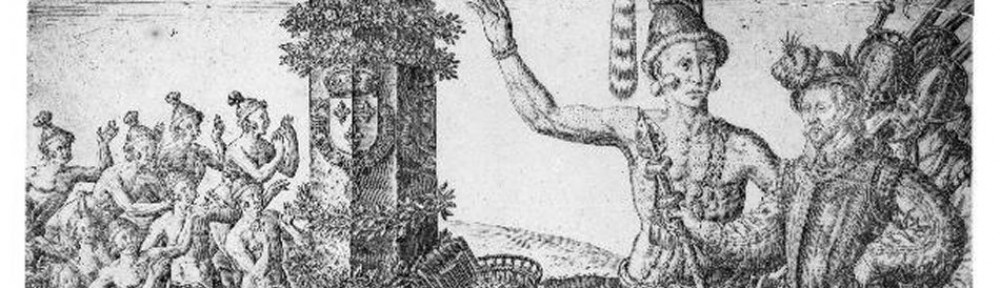
Alonso Gregorio de Escobedo, O.F.M. La Florida [ca. 1590-1610].
DRAFT TRANSLATION. Please do not reproduce without permission. Readers are encouraged to consult a revised translation, by Thomas Hallock, in The Epic of Florida: Selected Poems by Juan de Castellanos, Bartolomé de Flores, and Alonso Gregorio de Escobedo (Pennsylvania State University Press, 2026).
Canto 27: This canto contains the way in which Indian witch doctors play with fire, how other Indians fish, and the various ways in which they hunt.
(Folio 334r)
Just as the great craftsman divines
the most perfect gold in stone,
in temptation, all-powerful God tests
the most faithful to see if he is worthy;
and when those tested prove victorious,
God grants a thousand everlasting Mercies,
God grants promised pardons and good fortune,
that one should not die in misfortune.
The perfect stone was the previous canto,
which had as its theme the finest gold:
the virtue of the sanctimonious man,
whose bravery was tested by infidels;
and if he felt some fear, perhaps,
witness how God gave him strength
which was vanquished with the strong arm,
that banishes everlasting Death from death.
(334v)
With God leaving us in this desert land,
and amongst cruel people, as I have said,
that we should always stay on guard,
being in the towns of our enemies, the infidels,
even as we open to them the true door
of divine baptism, which offers shelter,
to those gentiles[1] for them to receive
the Catholic faith upon their death.
A true and righteous road is shown
even to those with fear in their hearts,
who need to be as strong as diamonds,
who seek to advance divine grace, God:
He, who punishes the wealthy, arrogant lord
and who rewards the humble sinners,
providing these pagans would put their lives
in His hands, and become faithful Christians.
Our short life is not much to sacrifice,
for He gave his life on the Cross for my sins,
and for those lost, idolators souls
who dwell in those far western reaches.
If they were to murder their vices[2]
and adore sweet Jesus everlasting,
they would rise to Heaven, victorious,
glorious in their everlasting rest.
(335r)
Oh great Father, I plead to you and pray,
give enough sweetness to my words,
so that the Indian who is most lost
knows the errors of his winding ways,
so that those who have offended may come,
that they can see light through the dark clouds
which that the treacherous deceiver,
Lucifer, the cruel liar, cast before them.
For those who serve the Indians of this land,
then, clear the space in their souls,
surround their spirit with eternal flame,
warm them with a holy peace,
bring them eternal fire in this brutal war against
those who pretend to follow sanctified principle,
those who had never sought your forgiveness,
who are not only sinful, but who sin over sin.
Of witch doctors, there are many,
who choose to enter into battles
juggling the hot flames of their fires,
made for this purpose in their huts.
Those who can handle the fire are
customarily given sacred titles and laurels,
while those who burn themselves lose
their fame and force, their position and place.
(335v)
I was witness to a pitiful case where
a western Indian (indio pontentino) burned himself;
so he could no longer walk, he lost his status and seat,
his knowledge failed, he became wretched and poor.
On the contrary, another was seen as powerful and wise,
coming away from the fire showing dexterity and skill,
having handed the flames without burning himself,
with such skill that the mob took him for a holy man.
So go the deceptions used by the enemy
in the expansive provincias[4] of Florida,
should one of them choose to challenge
the intentions of another one.[5]
These are the tricks ordinarily used
by these murderous (homocida) Indians,
bringing about death death in their blindness,
to the town with their vile promises.
They are a miserable and sinful people.
A people without justice (gobierno) or truth.
A people who worship vile demons.
A people who are all doomed to hell.
A people wicked to the Virgin Mary.
A people without sweet everlasting Jesus.
A people without their natural reason.
A people not like rational human beings.
(336r)
These people live on the beach by the sea,
naked, lacking any kind of clothing,
dressed only by morning rays from the East,
whose warmth gives them all their peace;
but without God, their minds are impoverished,
and lacking the reason given to man,
they dress as they please, jumping in
to swim with the fish at any new test.
It is a fearless nation, and made as such
that with great strength and swiftness,
they swim from the river to the sea,
without showing any sign of fatigue.
In what they have, they do not make
small gifts; in virtue only are they lacking,
and while they are great fishermen
they are not righteous themselves.
When the tide is coming in,
a number of the skillful Indians
enter into the water to start their fishing;
and as the sun sends its light to the earth,
armed with spears, they form a living bridge
that reaches from one side to the other,
and as the water rushes back to the sea,
the fish are left there on the dry flats.
(336v)
Clearly, as experience shows us,
fish out of water quickly die, these are
the laws of He who gives sentence;
the Indians who want to eat seafood
show great diligence in their fishing,
and with the use of handwoven weirs,
that are made just high enough
to keep the fish from jumping out.
The number (copia) of fish is so great,
that the Indians take with their skill,
that I must praise them for their efforts.
It is one of the best things I have seen
to show a proper instrument against vile vice,
to occupy themselves in fishing, for those who
choose not to atone for idleness upon their death.
The ponentinos[6] have another method,
where they take the net in each each hand,
taking in their catch with a continual motion,
trawling through the salty, brackish flats.
Wandering like pilgrims in this way,
the fish cannot escape because
of the dry spot in the narrow gate
they have built in the shallow pools.
(337r)
In the afternoons the generous fishermen
they share their catch amongst the poor.
In so doing, none of them are cowardly,
none of them act misers to the poor.
The beloved nobleman burns with a flame
that rescues and redeems those in need,
because he feels the hunger of those afar,
and the suffering of another is his own.
It is as they had objects of faith,
these lost souls would then be found,[7]
but because the vile devil awaits them,
they will find themselves nestled in eternal fire.
Were they to convert to the Roman faith
the wages of the sin they have committed
would be absolved by true penance,
and their souls cleansed from sorrow.
It is so that these traitorous infidels
who have been kept in shadowy darkness,
with the delight that my soul adores,
may be brought to the light of justice.
Can a town that treasures idolatry,
and that is always lined up for war,
in the soverign God find solace?
With baptism and the Christian faith: Yes.
(337v)
The lord of the vineyard arrived at daybreak,
and again at tercia, between sesta and nons,[8]
to gather laborers. And while some careless
late arrivers put themselves ahead of the others,
ahead of those who gave less time than the others,
the first were paid just as the last were paid,
leading the workers who had come earlier
to complain and plead their case to the Lord.
The Lord Said: “Friend, if the money is mine,
well enough for me to pay the last
just as the first; you speak madness
in complaining about your wages.
Take what I, your Lord, have given you
quit this vile plague of jealousy,
I do not pay fairly, or so you judge,
but for those who judge, I pay enough.
The Lord of this vineyard is all powerful God,
which is the Roman Catholic Church.
The worker is the religious community
who professes the blessed Christian law.
The last is the seditious Indian, who
keeps to the infidel’s empty sects;
but if the Indian who is as true as the first
he shall be paid with the palm of truth.
(338r)
Because they often have their arms ready,
they go to dry fields and light them on fire,
where there are herds by the thousands
of small rabbits, which the Indians hunt avidly,
some coming into the the hunter’s arms scorched
others blinded by the steam and smoke;
some meet their end in the high grass,
and others, killed by skillful archers.
Having a tremendous lack of food,
without the care of cattle and hogs,
the Indians and Spanish, to their satsifaction,
kill rabbits, ducks and geese;
and the unfaithful Indians arrive at the seat
of our leaders on the festival days
with the intention to split, hoping to sell
not just their fowl but their pavo real.[9]
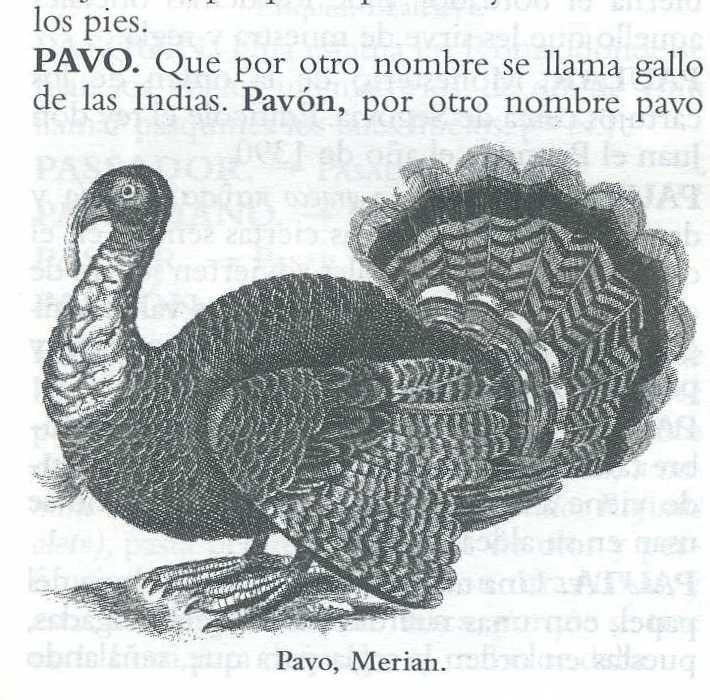
They value a bird called “montesino”
(which they raise in abandoned fields,
and is killed with an arrow by the ponentino
or by our loyal soldiers with a bullet)
priced at fifteen and a half reales of fine gold,
for the taste of this fowl is greatly valued;
one bird for one real, or two for the rabbits,
is plenty enough for the man who is famished.
(338v)
They often tear through the hills (montes),
skillfully, following the most narrow paths.
The speed of the light-footed dear
avails little against the far swifter arrow;
it flies straight through the life-giving heart.
The fleet deer proves to be no match,
and with the second shot it dies,
taken down by the hunter’s homicide.[10]
They take great quantities of game,
which is esteemed by all soldiers,
and the skins (gamuzas[11]) are of better quality
than what is made in the land of venison.
The Spanish gentleman, of noble race,
hunts them in the remote hills,
leaving behind the ease and the luxury of court
to suffer from rains, from wind and the storms,
They make a morish boot, the famed
borcequí, which I have seen for myself
as worn (calzar) by noble gentlemen,
who shoulder it like a great cape;
in this way, it was worn by the admirable
Pedro Menéndez, general and friend,
a prudent man, a worthy man, haughty
when led to be and calm when at ease.
(339r)
In La Florida, doublets customarily sell
for three ounces of Mexican silver;
and these are cut at half the length
of the doublets worn by Spaniards;
with these the Spaniards do not lose their life
to the lost idolators, infidels and pagans,
for without them, the Indians would kill
even the fiercest, rugged and strong Spaniard.
And upon my word, I write the truth:
that these doublets cannot be
pierced by poison arrows, even
when launched by a powerful hand,
the skins are folded over eleven times,
so that the Spaniards goes bravely
into battle against the Indians, who
strike, always, with a steady hand.
When the arrows strike a soldier
in the chest, he breaks them,
giving repayment with bullets,
not letting their arrows be used again.
From this the Indian feels a rabid disgust,
he is consumed with burning rage,
he is no longer to bring about their death,
because his arrows have been broken in half.
(339v)
Were they not broken, they would hurt our friend.
The unruly Indian (cimmarón), our enemy,
would make use of the unbroken ones,
gathering up the sharp arrowheads.
If they gathered them, I am faithful witness,
they would restock their empty quivers,
and return again to the field of battle
against our soldiers who dress in mail.
That is why our soldiers our soldiers
break them, as I carefully explained;
by doing so, they break the thread
of intent of the swift Indians,
who always sharpens the arrow points;
to bring death to our faithful soldiers,
with those arrows that fly straight
to their eyes or head, chest or neck.
An Indian from this fierce nation, full of vice,
will sometimes kill the faithful Christians
by burying his entire body in a field,
making a great[12] sepulcre in the sand.
With the bow and flying arrow
in his hand, he waits for the sound
of footsteps of some poor traveler,
who by his bad fate, is caught unaware.
(340r)
The Spaniard and the Indian then return,
after the armies have finished their war:
the faithful Christian to his pernicious games,
and the unfaithful to their task of fishing;
and to their idolatries, being blind men;
and to their hundred whorehouses, their squalid vice;
and to all below, which with my pen,
which will be recounted, in brief sum.
Now they kill cranes, geese and ducks;
now the ducks which I called montaraces (turkeys);
now they pull sweet potatos from the soil;
now they harvest the mounds of beans;
now they busily hoe the savannas;
now is the time, between war and peace,
now to sow their maize for food,
which gives them life because of God.
Now they sow melons and squash;
now they water the fields they have sown;
now they gather heaps of watermelons;
now they grind the corn that was toasted;
now they gather great quantities of shrimp;
now they fish for skates (lizas); kill the flounder (lenguado);
and hunt corvinatas[14] with arrows,
in this way, satisfying their hunger.
(340v)
And though it may seem rough,
what I want to say to the Castillan
to not believe me would be quite rude,
so I swear by my faith, as a Christian,
to the truth: of the deed I describe,
there are notarized and sworn witnesses,
whose signatures are there to certify,
for anyone still who is not satisifed:[15]
how they wade into dangerous seas (charco)
to hunt and kill a full-grown whale;
and alone, the brave and strong Indian,
seeking to deprive the whale of its life
dives with great fury on top of it,
until he has worn the whale down;
he holds on, and if luck goes his way,
he brings about the poor whale’s death.
With great speed and agility, he takes
two stakes and, using a club,
drives them into both ears, harpooning
them with obvious courage and skill.
If everything goes according to plan,
and the whale is given furious chase,
others approach in their canoes,
tying up the whale with ropes
from both sides of their canoe.
(341r)
If the stakes stay fixed on their target,
and if they remain stuck in the ears,
the Indians pilot their canoe
as if it were tied to a fortune
It is a lesson learned from their ancestors:.
that if the ears remain covered, in time,
they can make it to the beach,
with no escape for this ferocious beast.
They deprive this whale of its life,
and as I have said, if their luck holds
they share this rustic food along
the sandy shores of the sea,
and it is believed by all that[16]
this food gives strength and life,
and these ponentinos being without bread,
eat this, continually, in its place instead.
It appears that the whale has its home
along these smooth and sandy coasts.
The excrement is turned into ambergris[17]
which refreshes (refrigera) the human nose.
Gentleman of great intelligence and skill,
as well as the gallant and courteous lady
appreciate giving off such a scent,
esteemed by kings and gentlemen.
(341v)
These primitive (natural) Indians
carefully search along the shores,
and knowing how precious is the scent
walk back and forth, a thousand times.
They gather great quantities avidly,
for when a ship passes near him,
the passing Castillians give them
beads made of glass as payment.
It is such, the fragrance that spills
from this precious, fine amber
for the genteel, well bred Spaniards,
that when the unworthy Indian[18] brings it,
he burns in ardent, amorous flames
eager to give this gift to his master,
bringing to his lord that treasure
more precious than pearls, gold or silver.
They approach in woven boats (canoíllas)
surrounding the sailors on both sides,
with hopes that the ship strikes a shoal,
bringing death to the faithful soldier.
He is not able to meet the challenge
as the Indian here appears to be calm,
in his false bearing, detestably tame,
while inside, hellishly violent, abominable.
(342r)
Oh, the poor ship that nears the shores!
There, sailors will come to see naked people,
in canoes paddled faster than post horses
by this nation, as blind as it is stupid.
Our men pay dearly on this coast,
and when taken captive, are struck dumb,
amazed by those who practice idolatry,
and are such rabid enemies to Christianity.
But if they could see themselves as inferiors,
then they would come to ask for forgiveness.
We have seen it ourselves from these traitors,
and look away from their beastly dementia.
From the fury they show our gentlemen,
thus, we offer only with gracious resistance;
we do not seek to avenge the deep malice
of those greedy ones who wish us dead.
Dressed as sheep on the outside,
they are blood-thirsty wolves within:
these savage horrible, and fierce infidels
board our boats before we can drop anchor.
Without waiting for the anchor to set,
the captain, pilot and sailors
take what is offered for ambergis
greedily paying the pagan’s price.
What the sailors trade aboard the frigate
does not hold hold the same value,
or worth (fundamento) as the ambergris,
which is coveted more than I can recount.
Neither pearls, nor emeralds, gold or silver
can equal the ambergris in its qualities.
The Indians exchange at one hundred to one,
and leave contented, with no suspicions.
When given something like scissors,
they regard it as the richest treasure,
and likewise for a large spoon, which
they would not barter for pounds of gold,
more than the cutting board of a loom (cortadora);
in greater esteem than the Moor for Allah,
they love a fish hook, whether large or small;
it is more valued than heavenly God above.
It is the fishhook that gives them life,
it is what gives them the greatest joy;
it is what brings food, nourishment,
to the Indians, strong and weak alike;
he, who amongst the faithless,
leaves the bargain without goods;
if the western Indian, most courageous,
is left lacking, he is sad and weeping.
(343v)
They lack maize, having no grain,
for being on the dry, sandy coast,
these pagan barbarians are left
to feel the pain of what they need.
They eat only in Winter and in Summer,
as I have said before, from the whales,
or from what they catch from hook and cane (caña),
in the waters bathed by that golden sun.[19]
Although it is true, what I have declared
in the present canto, there are great quantities
of fish that the Indians take in
the province where I was in attendance.
There are no limits in gathering ambergis
from when the sun gives light to the day,
they fish in coves, with canes and with weirs,
catching many trout and delicious eels.
I can say this, because I was witness:
on the treacherous costa de Carlos,[20] where
I was on one of our own small ships,
one long night, in a dangerous pass,
while coasting the rocky shoreline,
the winds would not come to rest
winds howled from the northwest,
and even the most valiant was afraid.
343(r)
We did not haul in our iron anchor,
and as the sun brought its golden light,
we were grasping two thousand trout
by the neck, with many more dorados;
and lacking salt in these remote regions,
the captain ordered his soldiers to cut open
the fish. They were dried in the breeze.
They gut the fish immediately,
and over fifteen days by my count,
and we went hunting along the shores
of the formidable looking sea,
while a corsair, seeking to make landfall,
was robbing upon the high seas
silver from our faithful Christians.
I was Chaplain for our people,
who professed from their hearts,
upon death to avenge the insolent.
The most cowardly of them showed
great courage, to great satisfaction
And here I will promise to proceed,
continuing tomorrow, on this theme.