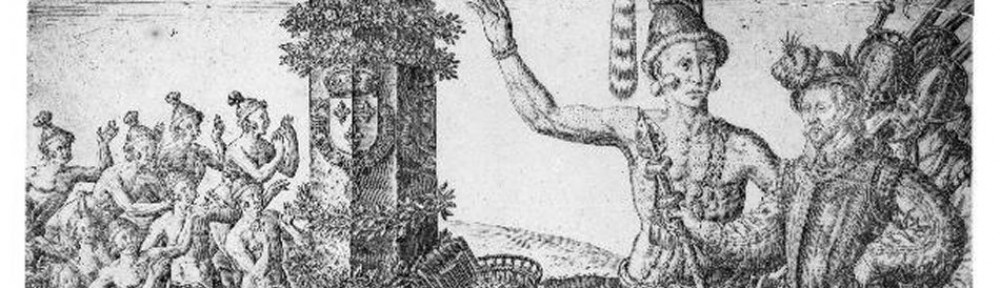
Alonso Gregorio de Escobedo, O.F.M. La Florida [ca. 1590-1610].
Please do not reproduce without permission. The following is a draft translation, prepared by Thomas Hallock, in support of The Epic of Florida: Selected Poems by Juan de Castellanos, Bartolomé de Flores, and Alonso Gregorio de Escobedo (Pennsylvania State University Press, 2026).
Canto 29. A certain corsair with four thousand Frenchmen built a fort in Florida. Their armada came to steal what was ours. King Philip II sent Pedro Menéndez against the enemy, and the Spaniards won the battle, killing two thousand Frenchmen.
The desire increased for he who waits,
hoping, even as the luck never comes;
the hope always seems to arrive later,
until where there was hope, there is despair.
The sentinel of hope brings him strength
and sees him along the hidden pathways,
keeping his sights on the royal highway,
where his view is ordinarily trained.
How many times would I turn my own eyes
to see how the rising sun shows its face,
and it strips anger away all of my anger!
That she who waits within would feel them.
I would enter that field of sharp briars
to see the clear rays of light from the East,
and to serve by describing a battle
that was beyond the reach of sun and sea.[1]
This true history will be adorned
as my feeble memory will allow;
I will not add or remove anything,
to add or take things out is serious.
Instead I will follow what I have learned
from the people who were there and who know
what occurred, this being what the discreet
reader would perhaps want to read himself.
I rightly think it is better to hear
what is clear and true instead of fictions;
I open the gates of honesty to
all and not those of the true relations.
Because the ordinary man, hearing
songs of romance and sonnets, is deprived
of his solace and repose when hearing
instead about the rigorous blows of Mars.
But now that I have described the clothing,
the customs and rites particular to
these miserable Indians, whose sad fate
it was to be born under a cursed star,
it is reasonable to turn the focus
of my words to our soldiers living there,
and surely no one would regret it if
I chose to continue along those lines.[2]
A certain Frenchman, with many people,
and full of jealousy, defiantly came
with an infinite number of people
to challenge and rob our Orient fleets.
This young man was insolent but dashing,
agile and keen, full of strength and brio,
gifted with a skill in arms that he could break
into a thousand pieces what a Leon had done.
Though he was not yet thirty years in age,[3]
he was animated and bold at war,
dexterous and courageous. His skill was known
throughout his own country and far beyond
as a giant, in stature and repute.
His name was Ribault, and from East to West,
in whichever way the wind was blowing,
a more valiant soldier would not be known.
And as my brief history will now recount:
this insane Frenchman came with the intent
of looting our ships; as they sailed across
the sea, he brazenly unfurled his flag,
after following them along their route,
and the sailors who freighted the silver spoils
saw in the emblem of the fleur-de-lis,
instead of flowers, what looked more like thorns.[4]
Jean Ribault recruited the worthiest
from the land of the enraged French King,
and they followed the fleur-de-lis on the
flag that was carried by this famous man.
all of his followers had brave hearts
and each of them eager, ready to show,
that they would kill, or perish in the fight
who made resistance against their leader.
It was Ribault who gave food and lodging
to four thousand Frenchmen, in twenty-one
ships, and as their leader, outfitted them
each with a breastplate, helmet and broad sword.
And it was this same valiant man whose brio
led men to follow him to journey’s end,
stopping where the western Indians were
outfitted in their fine and supple leather.
And it was this Ribault who neared the long
and dangerous coast of la Florida,
intent on depriving the Indians
of their food and Spain of its famed silver.
Here passed a great time of his life, a life
that was not alive but afflicting death,
in a foreign land with no sustenance,
without God and faith, sacrament and law.
He set anchor in the rapid current
of a river he called San Mateo,
and he remained courageous even here,
proving his renown with a thousand deeds.
With his brave French companions by his side,
Ribault built a fort like a righteous man;
this man was the same many who befriended
an Indian, our evil enemy.
This raging river, the San Mateo,
bursts and swells with the currents from the sea
and as I now see it, in the present,
I am afraid to watch the tide come in;
it rises with such force that I believe
the river looks like the salty sea,
and it is so violent in its course that
the wind carries the birds with it upstream. [??]
If the water runs against the current,
what will happen when high tide returns?
In my life, around the entire globe,
I have never seen a river like this.
No anchor can hold against the flood tide.
If a galleon does not hug the bend
and sails instead to the middle, it will
be swept up in the swirling current.
The powerful city of Havana
has a port from which the king’s armada
and royal fleet leaves, by a certain route,
through what is called the Bahama channel.
Towards the start of a successful journey,
the flagship vessel in the armada
sails around the point, or cañaveral,
where the cane grows alongside a freshet.
As soon as all the ships round that border,
they are given free reign to race Eastward,
following their path across the sea to see
the prosperous, promised mother Spain.
Each of the frigates follow the flagship,
never going down, freighted with the rich
store of our government, not stopping
until they reach the bars of San Lucar.
And so when the French noticed that here was
the point from which our fleets disembarked,
they offended my God, whose justice shines
like the sun, by breaking for Florida,
setting out with their entire militia,
in their foreign armor and leather vests,
to rob the ships with their holds carefully
freighted with shipments of silver and gold.
When our Spanish are surrounded by such
a galleon of Lutherans, in fine mail,
who approach them and call out for a fight,
they show such arrogance in battle that
their actions appear to be inhuman,
but they are brought to a sad death, for
the French are nothing but pirates and thieves.
Some of our brave people were conquerors
and some were deprived of their happy lives,
but it is remembered throughout the West
and in the enlightened nation of Spain
how they tied together not only those
on the front lines who were occupying
Florida, but also Ribault, that brave,
subtle, valiant, dexterous, and agile man.
It was Ribault, with his brave companions,
who as a thief, and for many days, stole
silver and gold and great sums of money
from our people along various pathways;
he sent to France a thousand spies, along
with the goods that he stole from passengers
and he felt tremendously rewarded
knowing where the stolen gold was going.
But when news arrived of this great evil
to Philip the Second, the King of Spain,
and when he realized how the jealous French
were acting crazily and without shame,
he assembled a defense, and ordered
it to be led by a general of skill
and great repute, the bravest of pilots
that could be found across the Occident.
This man was known as Pedro Menéndez,
the Asturian, and his commission,
dictated and burned into memory,
was signed by the King’s honest hand, reading:
it is agreed that this faithful Christian
should bring death to the dissipated French
people and that he should leave them entombed
in sepulchers belonging to Neptune.
The general recounted the pitiful case
to Philip the King in strict detail:
how a Frenchman, famed for his thievery,
had established a foothold in the West,
and how it was very important to
recruit good people to leave victorious,
and in so doing, how they would honor
his scepter, crown, and his very person.
The general brought eight hundred soldiers,
all of them gallant and stout-hearted men;
a military band played and gunshots
echoed through the wind as our eight hundred
Spanish infantry boarded ten low-drafting
vessels, which had been built to navigate
the shallow bays of the great Florida.
The king covered the costs of the ten
ships, and as I have said, he understood
how they would sail along a shallow coast
but not have shelter from the eastern wind.
Leaving with the certainty of a full breeze,
they went to find our enemy, Ribault.
The wide sea was flat, and the waters calm,
making it possible to reach their goal.
With faith in God, the King, and steady wind
the Asturian charted his course towards
where he thought he would find Ribault, even
from the middle of the ocean, for he
was a man of great capabilities,
chosen by Philip, the Christian king,
and recommended to his majesty
for his courage and skill, cunning speed.
His journey ended quickly,[5] with the path
leading him right where he wanted to go,
and he swore by the edge of his sword
that he would have the French understanding
the vanity and madness of their ways,
that he would take home the trophy for Spain,
and remove the enemy from their place,
sowing thorns where there was a fleur-de-lis.
Knowing that Ribault was positioned on
the San Mateo, where the river bursts
and flows into the sea, Menéndez raised
just the foremast of his little flagship
and peaking around the corner, he saw
the very arrogant royal fleet of
the French King, and with a ferocious voice,
he spoke the words that I will now recount:
“Ahoy, you on this ship, whose fleet is this?”
And they said that it was the King of France.
“Oh, thieves,” he answered, “I will pillory
you and hang your bodies from our topmast.”
Wearing leather doublets, with harnesses,
they destroyed the cables and anchor lines,
knowing exactly where to strike and give
the French the penalty that they deserved.
Sailing with Heavenly God in his heart,
Menéndez came within sight of the coast,
tacked his little vessel around the bend
and past the warning post of the French fort.
Although this sight was redemption for Spain,
it was not so for Ribault, who would pay
the price of setting out with large galleons
to fight against our valiant squadrons.
While we kept our smaller boats close to land,
they sailed their big ships to the open sea,
and when Phoebus departed at the close
of day, they were left twelve leagues out to sea.[6]
All of our men took joy in knowing how
Christ the Redeemer had supported them
in war against these thieves who had stolen
Spanish gold and silver on the high seas.
Our ships then entered into a river
that they gave the name of Augustine, where
no other ship had set anchor before–
and it was not only our armada
that was challenging Jean Ribault right now,
but also our God, the Father of man,
who raised a strong and twisting wind against
our enemy, stripping him of his talents.
Menéndez, general of the Christian king,
was an exceptionally skilled officer
and had found the bottom in that port, then
sailed after Ribault, still in striking range.
And when he heard an unsettling wind,
called the Eastern, from across the ocean,
he knew that the river gave the cover
to protect his royal armada, and
so he spoke in this way to his pilot:
“Consider me a false prophet, a man
of little learning, one for whom reason
never finds its right direction, but I
declare a clear and simple truth, that what
I hear is an unsettling wind coming
from the east, a Levant, that will break up
any possible passage through the sea.
Although Ribault has one hundred ships,
his people will be blown up to the coast;
I will go at the first light of the sun
We named this wind after where it comes from,
opposite the wind that blows from the West,
and were Ribault to have one hundred ships,
his people would be thrown upon the coast.
So at the first light of day, I will look
for some Indians who can direct me
to the French dwellings and principal fort,
where I will give their sentries a cold death.
Leaving behind two hundred men to guard
the ships, he set out with the remainder
to complete their important task, beating
a slow and silent path to the French fort.
“Hijos,” he said, “it is my fervent wish
and burning desire to bring the French to
a quick death. We will ask a poor Indian
if there is a path to the French castle.”
And being God’s will, an able-bodied
Indian, agile and extremely strong,
showed them the path to the French fortress,
this being a most precious gift from God:
Our Lord always brings aid to the righteous,
to those who put the reins on their vices,
and it so being, a path was shown to
the Asturian’s brave Christian army.
Following a narrow and unused path,
the Spanish men filed behind their guide,
not reaching the end of their journey until
two hours before the break of day came.
Extremely content with their position,
they hid themselves in the woods for a while,
and then the general called to a soldier
who was practiced in the French language.
And he said to him: “God gave us the strength
to follow that path; now undress that fear
and put on the clothes of audacity,
something the French do not understand.
Walk slowly, going step by step, but if
anybody notices, do not take
alarm, for there is no loss in taking
the life of the sentinel guarding the fort. [??]
Put him to death then come right back to us,
so you can report to me what happened.
I will be waiting here. I am on fire.
I take no pleasure, find no other diversions.
And if you cannot return, speak to them
in their own tongue. Go as the hungry wolf,
feigning serenity in the sheepfold,
and cry out the tragic news to Ribault.
Tell him that the strong fleet of a dozen
ships sank because of the Eastern wind from
the day before yesterday, and that now
you come forward as a sad, crying wretch.
If the guard leaves you for a moment,
then take the captor’s soul with your sword;
And if over France you seek victory,
fix this now upon your memory.
The spirited and courageous Spaniard
followed his orders without missing a beat.
Showing more care than I can describe,
he traveled bit by bit, with breaks between,
in slow and measured, even lazy steps,
until he saw a nearby French soldier,
to whom he recounted his tale of woe,
falling into this sad and shameful state.
The Frenchman believed him and let him pass,
and when he came close enough to our man,
he attacked the sentinel with his dagger,
landing three stabbing blows with his dagger,
before returning across the wide plain,
and feeling both happy and contented
with himself, he told General Menéndez
about the fortunate outcome of his deed.
“Now that you have killed their sentinel,”
Pedro Menéndez said, “the only thing
remaining is to go to their little
castle and repeat our woeful, sad tale.
Tell General Ribault to open the gate
because it is freezing and it had
been lunacy to oppose him. Tell him
once more, lower the gate and open up —
“Lower your guard and open up the gate!”
“If it opens before the break of day,
I have a prize of three hundred reales.
It is as cold here as it is in France;
my face, hands, and mouth are freezing,” he said;
“I would freely part with all the silver
that I own,” he said, without arrogance.
“If I win, it is yours, but if I lose,
I will complain for the rest of my life.
The French guard opened the gate, allowing
our soldiers to ferociously rush forth;
the soldiers inside this sepulcher fort,
dreaming the sleep of dead men, awoke
to the blades of Toledan swords splitting
their heads in two pieces. Such was the prize
deserving for these treasonous thieves, who
were trespassing on someone else’s land.
Fortune fell on the side of the Spanish
who leveled their strong arms against the French,
wounding and killing them; as the carnage
increased, the French felt tremendous hardship,
and in fear of invisible death, they
surrendered to the brave Asturian
and his courageous Christian army.
In this fort, two thousand gave their lives,
bringing their treason to a rightful end–
and to what they practiced, it was farewell.
How was it that the illustrious French
of Florida suffered death in this way?
What did it mean for these thieves to construct
a strong fort, living in fancy rooms,
but against the laws that God gave man?
Showing great respect, Pedro Menéndez
spared only one man, a surgeon named
Master Juan. The Asturian did not
put the physician to death because
he was a wise and competent surgeon,
and the general looked to the common good,
it being a tremendous advantage
to have an officer who could attend
to any soldier who had been wounded.
When the brightly burning sun had risen,
bathing them in its famed and lovely warmth,
Menéndez made a complete inspection,
and with a great display of gallantry,
he gave thanks to the omnipotent God
for the victory he had been granted,
losing only a few soldiers with the first effort,
and only a few in the battle to come.
The right to plunder as much as they wanted
was granted to all Christians, and they took
as much as they were able to carry,
setting aside only Jean Ribault’s room.
I cannot begin to describe the treasure
that these tyrants kept in their great castle,
nor can I recount the store of riches
that the French had stolen in Florida.
Pedro Menéndez entered the room where
the French Ribault had his bed, wanting
to see the treasures that were locked and stored
in the most protected part of the fort.
No one else was allowed to enter where
the greatest portion of treasure was hidden,
where in secret hollows they found riches
such as emeralds and pearls, silver and gold.
There, in a room that had been upholstered
at tremendous expense, Menéndez found
a brocaded doublet, dagger and sword,
and a hat that had been decorated
with various kinds of feathers. As was
the usual custom, the strong soldier
Menéndez took these things from the Frenchman
Ribault to show that the fort was now ours.
Following his king’s command, General
Menéndez wasted no ceremony
on the French and used as a sepulcher
only the tempestuous, open sea,
where the bodies were sure to remain fresh;
they were offered as delicacies for
the fish, so anyone who goes fishing
in this foreign place should not feel despair. [??]
“What right do you have to seize the bounty
of Castilian riches, thirty years after
he submitted himself to enter Peru,
where he came across many bizarre things,
only for those of you born in France to
do a thousand harmful things in our lands?
That is not the law of God, it is not
what noble and pious Christian people do.
It was through our adventurous Spaniards
that victory over the enemy was gained.
It is the precious pearl of instructor,
as is well known among all our people.
And it has also been well established
that to God goes the glory of victory,
as is signaled by these heroic deeds,
such as victory with our sharp swords.
0h, Spanish nation, within whom is bound
the valor of brave and ferocious Mars,
where visible cunning in war is trimmed by
the graces of industry, learning and art!
Oh, nation that takes others as its own,
carrying forth the standard of valor,
yoking the greatest valor to us with
the strong ties of opportunity’s forelock!
Say it to the Moor, Turk, and Lutheran,
sing about our greatest deeds in China;
Rengo and Tucapel, Cauplicano —
let these foes remain indignant of you.[7]
From London they speak of the courtier,
of the valuable honor depicted
by the flag, adored by flowers,
won by don Bernardo del Carpio’s sword.
To conclude: courageous Spanish nation!
of your heroic feats and deeds I sing,
even though it has pained me to go on
about Jean Ribault’s breastplate and armor,
You stand alone in valor, Señora,
you are a constant on the battlefield,
as you will see in what I have to say,
and in what I said, I swear to be true.
***
[1] A confusing couplet: “para ver [y] servir una battala / que el sol y el mar pararon a miralla [mirarla].” Falcones translates these lines to “but let tell you about one battle, witnessed by the sun, the sea, and me” (155). This line, and the following two Cantos (29 & 30) flashback to the 1560s, a full two decades before Escobedo’s arrival to Florida.
[2] Couplet reads literally: “que a quien no lo supiere dará gusto, / y a mí por lo contar ningún disgusto” (to those who would take pleasure in knowing / a for me it would be any disgust to recount).
[3] Jean Ribault (1520-65) was actually in his mid-forties when he enters the story (Sununu 930). Here and below, Escobedo exercises poetic license with numbers.
[4] I have taken liberties with this stanza, reversing the order but also embellishing the thorns (“que se volvieron todos en abrojos”); Covarrubias notes the religious value in a long entry, “abrojo,” noting this “mala planta” is a symbol of bloody tribulation.
[5] According to Andrés Barcía Carvallido y Zúñiga, the trip took two months, with a storm forcing Menéndez back to Cádiz and additional stops in the Canary Islands and Puerto Rico (Sununu 940n).
[6] A league is three nautical miles, leaving the French roughly forty miles at sea (during a hurricane).
[7] Three chieftains memorialized in Ercilla’s Aaucana (1569, 78, 89), indicating that Escobedo had read this colonial epic (Sununu 953n).