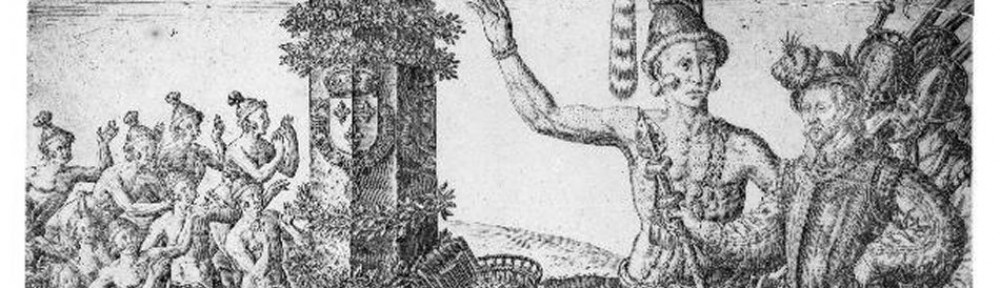
Alonso Gregorio de Escobedo, O.F.M. La Florida [ca. 1590-1610].
Please do not reproduce without permission. The following is a draft translation, prepared by Thomas Hallock, in support of The Epic of Florida: Selected Poems by Juan de Castellanos, Bartolomé de Flores, and Alonso Gregorio de Escobedo (Pennsylvania State University Press, 2026).
Canto 32. This Canto contains a sermon that I to Christian friends and to Indian enemies, declaring how much God hates pride and loves the excellent virtue of humility.
By order of my God according to Ose,
the upraised head will be humiliated
because this behavior clearly evidences
a man’s miserable and wretched fate,
while the fate of the lowly one who is employed
and is in service of the crown of glory,
the faithful man who who humbles himself —
he shall rise from everlasting sorrow.
Those creatures who do not love God
and put their love in him fall into disarray,
it brings them misery and misfortune
to find themselves without God and in sin.
This was seen in Nabuth,[1] whose idol
was worshipped by the people on bended knee,
when worship was due to God almighty,
not to another idol. God does not consent to that.
After Daniel, as a holy prophet,
interpreted an opaque dream for the King,
he found himself on the straight track to doom,
who wanted to be secure with the true God [?],
for seeing the indiscretion of self-promotion,
as God had promised to Nabuth
the penalty merited such a crime
in offending God’s infinite goodness. [???]
As a punishment, Daniel was deprived
of his command, his royal scepter and title,
and after being like the ox fed on good grass,
he wandered about for seven years
walking the mountains in exile[2]
because he had defied his God,
going against the just sentence of this King,
and not accepting his omnipotence.
After those seven years had passed
God returned to him the reason he was lacking,
and as well as all the powers he had known
and that the eternal Lord had rejected in him.
His kingdom and servants were welcomed back
by their Lord and Ruler, who showed them loved;
God, the one who issues punishment
told the King he was outside the law. [?]
Nosor then occupied his royal seat,
and gave thanks to God, the eternal Lord
of the Heavens, for His everlasting goodness —
he who had been afflicted was brought goodness.
The King created a space for his soul,
and he confessed that, yes he had limits,
and with great humility he accepted his good fortune
which stayed with him until death.
And because of his humility he was given
a seat next to the Virgin of heaven, emperor,
for there the deserving soul who humbles itself
will dwell with Christ the King.
And though King Ahab[3] worships the Devil,
he showed such such wonder in the sovereign lord,
and was himself humble, so that when God commanded,
he also stepped down from his throne. [?]
If the son of this King was left to suffer
for punishments that the idolatrous father deserved,
it because he was accepting full and humble,
and his soul was not full of pride.
David put Uriah in chains,[4] sentencing
him to a bitter death that he did not deserve,
but then when Nathan took charge,
God released him for being humble.
With these same pains, and without arrogance,
his son dies without any complaints.
God granted his mercy upon David
and seeing him contrite, he gave him shelter,
just as he healed the publican of the ailment,
because he was a humble and valued friend
even though it would have been justified
for him to receive the same punishment as the Pharisees.
God castigates the Pharisee
for being close yet also distant from Him,
while the humble publican, even though
apart, wishes to be closer to God;
I am not worthy of you,” he said to the Lord,
but to you I confess my sins.
And the Pharisee accuses the publican [?],
despite his earlier office as tyrant.
Being with God, source of infinite goodness,
he went into the house prayer with respect,
and the gentleman said to him [?], said “be discreet
in house prayer and weep for your sins.”
Wise Solomon, who was chosen by God
to leave what was written as a divine science,
has said that those who call out to God,
will be heard, as is fair, in his house of prayer.[5]
God has seen enemies in his house,
one of whom we know to be know Martin Luther,
who clumsily took up the reins
until he reached a lustful [lascivo] dead end,
and with false doctrine he lost the direct way
to the faith of Jesus, meek lamb,
and he create his misinformed, false sect,
and which they lose the ways of, and life in, God.
This traitor, and others, waged war
against our Lord and God, but brought them to death,
because they brought an infernal, terrible, strong poison
to the simple ones of this earth.
This was how a hundred thousand souls
were fated to be buried in eternal flames,
because of the infamy of their friend
who was not just a traitor, but their enemy.
Who could believe that the Pharisee
would be such a cruel enemy to the publican,
showing his great madness and poor judgement
in saying before God such bad things about his brother; this ugly case cost him his life,
when he could have extended his hand,
gone to the temple where he had lost God;
instead, the grace he enjoyed went away.
The heart of the righteous must be
well prepared to enter the temple of God,
for if comes to pray as a saint
he will receive whatever he asks.
But if he enters with evil intent,
he will get whatever he deserves,
which we know he gave to the accuser
to the humble, and thus was justified.
That Joseph, speaking as through the mouth
of a prophet would say: “It is not reason that my beloved
in my own home, appears to be perfect
yet commits evil as an imperfect one.”[6]
Which of God’s law does one follow? What straight path?
He who chooses to worship an idol,
making the decision by his own account,
despises what is right and true.
He who is wronged along the way,
even it is not deserved and is a great affront,
does not complain about the damage done
in his own home, because that is where it starts.
The criminal is deemed worthy of death
because of the freely-chosen treason
and ugly gravity of his own sin —
it will bring down another close to him.
Asuero filed a lawsuit against Aman
because he wanted to impose upon his beautiful wife
Ester in his home and before his own presence.[7]
He showed his mercy upon him
because the queen was naked [vulnerable?] before him,
and it fell within her power as queen
to bring the traitor to death with a strong arm,
because he had intended to kill her.
In this way, the blind man sins
against God in his holy house,
because the confessor’s plea was not enough,
it did not offer reproof of the living ember,
nor did it extinguish the terrible fires
of vice that takes one to hell,
and so the Christian must be vigilant,
if he is to banish the errors of his mind.
Never had the Lord been so indignant
than when he saw the different kinds
of livestock there in his temple,
all the animals to be bought and sold.
Every of of those merchants were banished,
followed by punishment with a whip,
because, “my house is not a shop,
where things are to be eaten or sold.”[8]
My brothers, it is better to be holy
in the church, for the temple is as your own cell,[9]
each should be warned that to not work
together, in one faith, is to be a bad Christian.
See how the self-important Pharisee came
into the temple, taking death into his own his hands,
and did not nor the life of this sacred place,
nor would he give life to you if you were sinful.
It is better for us to understand that our prayers
will not fly to their heights, if poorly asked,
because he was calling to God in arrogance,
with crazy words, saying to Him:
“I give you thanks, Lord, and if I gave them,
on this an occasion, it is not my soul
which is like that infamous publicans,
who commits the clumsy sins against his brother.” [??]
To say as much is a sign of arrogance,
and our eternal God punishes for such sins,,
for it is only the humble heart without pride
that is pardoned with forgiveness.
The man who humbles himself, who stays
down to earth, finds that his prayers penetrate
the clear sky, because of its friendly face,
and he draws the highest comfort from the Lord.
If the Christian is not humble in prayer,
what profit or fruit will it yield?
If it is does come from the hand of one who is humble,
the prayer meets no resistance in finding the hand of God;
to enter without resistance to the right God;
the prayer that meets God plainly very plainly
is met with satisfaction, redeeming the sinner.
That is what the Lord wants, as he commands us,
“Ask and he shall deliver.”[10]
Solomon the wise was chosen by God
to be a mighty king, he though he obeyed,
to our Lord or God as the Divine Object,
the one who brings joy to all he created.
Daniel also held Him in the highest respect:
three times, each day, he prayed to him.
And Moses, leader of the Hebrew people,
won his laurels and trophies through him.
And the most righteous to ever worship him,
the apostle John, saw how the lords
fell to their knees in acts of humility,
making obeisance along with the angels.
He saw how the angels knelt before the throne,
and how the host of angels, full of love,
would sing, “Holy is God Almighty,
who punishes or gives reward, as is just.”
And so this great Lord, the Indivisible Goodness,
offers to the righteous soul that calls to him,
giving by this notice to understand that
the soul which gives itself to God is loved in return.
And it was by God alone to be crucified
on the divine cross, precious branch.
By immense charity, he brought to the ground
so the righteous could be carried to the clear sky.
Whoever wants to reach Him must be
humble and circumspect in prayer,
and not like the Pharisee, would treat
God arrogantly and without respect.
He fasted and said, “My soul rejoices.”
It was vanity to the living object,
and deserved to be punished by God,
because of the wickedness of his sin.
The Father seeks the faith of the sodomite,
the one who humbles himself and says
to God, “Lord, you are the cure;
Do not swallow the seed of the evil one,
for while I know that I am a vile creature,
you the Highest God have made me a royal seat,
and I beg of you that you hear my plea,
and concede to me all that I ask.”
He spoke, so it could be more clearly said,
“Do not be angry with us, eternal God, because
I am the vile one, and I ask that you would
brant forgiveness to you enemy.
And is Jacob (who puts his God trust in God) does
recognizing the poor beggar who says
that “I am the smallest, and in the great scale
of your immense power, I have been freed.”[11]
Humble in the presence before God,
David thus asked of him: “Who am I, who is my house?
For me to approach you, the omnipotent King,
you made no charges, I did not have to bring anything,
for justice is your very essence.”
And as Daniel said of Adam: “The body is vile
if you, Lord, let her out of your hand. [??]
He who was Jacob yesterday, today is a tyrant.”
The good person expresses goodness at all times,
and in his humble prayer, he makes that known;
but he who does not always do so
is evil, and that confirms his evilness.
Because the the evil man who confesses to be good,
he will be the one who wears God’s rich garment,
for as St. Paul tells us, as far as God is concerned,
“thanks are to be made for the blessings he shows us.”[12]
Ezekial, David, Paul and Zackary,
all professed their virtues clearly,
and so, because as Pharisee declares.
a sentence against one, and he declares,
he wasted his time with Give in idle pursuits,
and wanted God to show the outward face
his of works, for thus he attributes them
and to give God thanks, he always fleed. [???]
By my account, there are three ways
to show this abominable conceitedness yourself:
the first is by, on your own, representing
the work of God’s unspeakable goodness;
this first was how Nabuth increased his own guilt,
because the response that he gave
to the prophet David was so obnoxious,
arrogant, crazy, vain and without discretion.
“Is this not the famous Babylon,”
Nabuth said to Daniel, “my strength depends upon it,
for if God’s hand is all-powerful,
so much stronger is the King who lives by that hand.”
“Listen, Nabuth, the voice of the glorious God
speaks to our Lord speaks through her,
and it says that your kingdom will be given
to another king, and you be fed like an ox.”[13]
This is where Samson’s luck ran out,
when after the victory had gone to God,
he said to a thousand Philistines, “I gave you death
death with the memorable jawbone.”[14] [?]
God struck him with a terrible and strong thirst
for taking away His honor and glory,
and he almost lost if life there
for his cruel and unconscionable arrogance.
Will the saw or axe holds up against the one
who cuts, slices, slashes or saws?
The king may rise up against his God,
and like a little worm, make war on him?
The ruler will be content with himself
when the evil one is locked up for a terrible crime,
and you will see that good comes from God —
as does punishment, both awarded as He so chooses.
What do you have, tell me, that you haven’t received?
These not being yours, why do you glorify yourself?
By falling into this belief, you are taking a risk,
making yourself a stranger in thinking it is you;
all of your blessings come from God.
I do not know how you would claim it as your own,
that would be great blindness and wandering away,
to think “what Lord has made is my own.”
Whether you want it or not, the soul you have
will be taken away, whenever they choose to do so,
and she and the kingdom to the king, and whoever
resists God will be thrown to the galleys of hell.
The Christians who wear the humble garments
will find God waiting for them —
abandon your pride, which is the same as a desire
for the hellish demon, and where evil grows.
Imitate instead St. Francis, my father,
who won the afterlife through his humility,
and who stripped himself of the seat
that the raving, murderous Lucifer had for him in Hell.
If you are to trust in God and be humble,
even if your soul were to suffer a loss,
or if you are make penance for your sin,
you will enjoy what the Lord has in wait for you.
It will occasion to the soul’s loss
to think that with God as the foundation,
good thing will come to everyone,
and that everyone is chosen by Him;
to him who lacks the talent of reason,
we know for certain he’s going backwards,
and by following the other, brutal path,
he will be full eternal error and blunder.
We do not have value or satisfaction
in thinking that something good
comes to us from of God, for He gives
alone grants mercy. We are in a stinking swamp,
if we think that we are not sufficient,
if we are the lesser work in these lands,
how you can perform any feat,
more difficult to you and more strange. [??]
Brother, if God the Father does not guide you
to Christ the Redeemer, you will lose concern
that you will not be able to follow the straight path,
and you will not be crowned in eternal glory,
making the doom yours, not mine.
Oh, village of Israel, you have been damned,
since you stop following me when I call!
More than a thousand fold is my love and affection.
You have locked away your help from me, sinner,
choosing instead to walk toward Hell.
Following bad inclinations, you make war;
without me you will never be a righteous man.
By your own choosing, your soul like water
that is banished from the salty seas;
you will not be able to navigate the currents
and travel from vice to the holy sources.
Mother Earth is a like a vile harvest
that, as a stepmother, bear good fruit,
and you, like a stupid horse, are going
straight down that road and lose yourself there.
For those bad men who do not follow the narrow road, God’s strong and absolute arm will not assist,
his arm will not frees you and raise you up,
giving (as to the slave) his papers of freedom.
“Without me,” says the friend of our Lord John,
“you can’t do right. It is impossible.”
the keeper of Heaven’s key’s, Peter, is a faithful witness
to this obvious and infallible truth.
God looked upon he who sinned and this King,
with invisible eyes made shelter for the sinner;
before Him, they were like like wax by the fire
melting into Christ, then Peter.
The second type of sin for the indulgent
is the one who believes he has already received God,
deserving mercies that he thinks have been given to him,
as merited by the title of merit he holds.
And in this claim, it has been declared
that he is a fool, for as it is clearly written:
he who thinks he deserves mercy,
because he has it and God has chosen so.
He chose the twelve vessels to carry
his sacred name, and to them he declares,
“For my sake you are now my apostles,
to go two by two before me.
I will make you fishermen of men;[15]
you are to go for me me, and I give you the rod
of my power. If by some miracle,
you, the traitors, shall now seek glory.” [?]
The third type of sin people depend on
is an overrated prop, or crutch —
it being a pride that, although mortal,
and they believe that all good comes from God
in his glory, they also bring onto themselves
hellish demons, knowing horrible punishment
await, a disastrous grief of their own choosing,
leaving by their own volition contentment aside.
The arrogant and inflated Pharisee,
in this manner, abandoned God’s glory,
as the story of Moses and his brother Aaron
in the desert live forever in memory:[16]
when water suddenly ran from a great rock
and the stream of water was so notorious
that the two of them never entered
into that land which they so desired.
The glory to which the immortal Christ refers,
says St. Paul, and that St. Luke allows
anyone to understand
is of this greatness realized.
Glory in the highest should be considered,
and God brought to within your chest
which was as it was told to them by the angels,
and would be leave us in their peace.
The blasphemous Pharisee declares
how he talks to God, and with great boasting says:
“Lord, I do not believe
that others serve you with constancy.
My self-righteous spirit feels
an arrogant sympathy for them,
for you are good only to me
and not to the other people.”
You adorn my soul with richness,
which is enameled by virtues.
To others you see in great poverty
and I despise them, for they have nothing:
not only is there virtue in me, but nobility;
in me, all else is eclipsed.
O infernal pride! Whoever would have you
is not admired in yourself, for God gives you death. [??]
Haman, who was deprived by the the King,
did not believe any other than him should be looked at,
and he said to the King: “I saw by my life,
tell me how to honor a faithful servant.”[17]
Haman was advised on what he wanted,
imagining he alone was deprived,
“Go then,” said the King right away,
“Mordecai will accomplish it all together.”
Without affront, and with what remained of his honour,
they hung Haman from a log.
And in this way God raises the humble,
fills them to the brim entirely,
the proud man’s sorrow increases,
he is brought back to earth
by all the army of the Inferno,
where he winds up tormenting himself day and night.
In him, you will find only dark darkness
because the light of light is always lacking,
everything there is misery and misfortune
because it the place for those doomed to punishment,
and so he left the breeder of the creature,
this is what the devil brings you,
will give you, for his crimes —
endless pain, endless infinite torments.
Those who, by their own wild decision,
choose to follow their own arrogance,
will be condemned, just as the Pharisee was.
Nosor was left to feed on disgusting grass
and Aman was hung from on the gallows,
and you, my Christian, if you are just
you will enjoy Jesus, King of Glory,
who takes you for vice to triumphant victory.
If are triumphant, brother, I promise you,
that the Lord’s forgiveness will be fulfilled,
you will be seen as the object in white [?]
if until today you have been a lost soul,
so let my persuasion convince you.
God will remain united in your soul,
and to those who ask in humility,
my pen will sing the next day.
***
[1] Nebuchadnezzar, also known as Nosor.
[2] Quoting Daniel 4:15-16 (see Sununu).
[3] 2 Kings 10.
[4] See 2 Kings 21:3.
[5] 1 Kings 47-48.
[6] Written in the margins, Jeremiah 11.
[7] Reference to Ester–Book of Ruth?
[8] See Matthew 21:12-13, Mark 11:15-18, Luke 19:45-46, John 11:13-16.
[9] Escobedo speaking to members of his own religious order?
[10] Matthew 7:7.
[11] Genesis 19, Sodom and Gomorra.
[12] Ephesians 5.
[13] Daniel 4:25.
[14] Judges 15:16-17.
[15] Mark 1:17.
[16] Exodus 17:1-7.
[17] Ester 3-10.