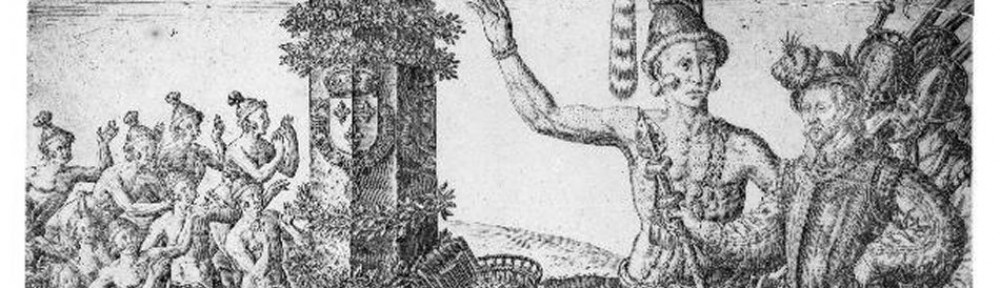
Alonso Gregorio de Escobedo, O.F.M. La Florida [ca. 1590-1610].
DRAFT TRANSLATION. Please do not reproduce without permission. Readers are encouraged to consult a revised translation, by Thomas Hallock, in The Epic of Florida: Selected Poems by Juan de Castellanos, Bartolomé de Flores, and Alonso Gregorio de Escobedo (Pennsylvania State University Press, 2026), as well as a selection in Derrick R. Spires, et al. (eds.), Broadview Anthology of American Literature, Volume A: Beginnings to 1820.
Canto 26. Concerning the towns and temples of la Florida, including the rites and customs of the “indios naturales,” specifically, their manner of waging war against our people.
Ask, and for certain, you shall receive:[1]
but those who pray to God with selfish or
bad intent will find His door forever shut,
because they had malice in their breasts;
while those who serve with a humble heart
shall find the same door forever open,
having won with their excellent virtues
the kind caresses of our almighty God.
To my God I offer supplication,
for I know little about about the Indian
rituals and customs of which I sing,
Given my ignorance, I make confession:
grant me the favor of your mighty hand,
despite the poverty of my discourse,
for me to encourage all true Christians
to have faith and abandon pagan ways.
When the day of judgement comes, what account
do those who were baptized here on earth give,
when our own sins are far greater than those
who had not been brought to the light of faith?
“How is it,” God will ask, “that as soldiers
in my army whose job is to follow
me anywhere through the sufferings of war,
you leave me for the pleasures of this earth?
That the Indian, Turk, or Moor be damned
for not knowing God — that is no marvel!
Out of every ten cases, there are five
for whom my soul is pierced and stained; I cry
for the madmen here in our own kingdom
of Spain that will not enjoy God’s treasure.
It is the painfully sad, bitter fate
that the faithful should die as infidels.
So I will now sing of the exquisite
and singular case of these infidels,
for we are at a tremendous moment
that now deserves to be rightly written.[2]
Not only will I give authentic accounts
of their miserable rites and their customs,
I will also describe the ornaments
of a people who live without care.
It is a loss for admirable Christians,
whose eternal souls hang in the balance,
and who issue sighs and moans with reason,
kindling the heavens with their burning tears,
begging God to withhold His wrath against
the Indians and destroy their idols,
because all of them, up and down the coast,
are on a path straight to the Inferno.
The coast of Florida is dangerous,
being surrounded by mountains and swamps,
and the bellicose people living there
are to the Christians rabid enemies.
The brave man who wanders into these hills
is lucky to come back alive, or if
he does, it is with arrows in his chest.
And while the Indians fought back fiercely,
piety these infidel people now proclaim,
after gunpowder broke down their resolve,
bringing justice where treachery once was.
Our weapons, perhaps, split open their heads,
so even the most and brave and insolent
warrior, the most spirited and brave,
has become an obedient gentleman.
They take pleasure in the torpid sin of
fornication, with slow and clumsy vice
switching between women at their own will,
and for this, the Indians die in sin.
All of them follow this sinful custom,
and they will be lost for their trespasses
against natural law, making them traitors
as well according to the laws of Spain.
I knew a cacique who had a daughter
and mother both pregnant at the same time.
Following his demonic fiction,
common people took up the custom.
If I intervened upon their evil ways,
they despised me; they thought it was nothing,
saying, “what you see is for our pleasure,
and if it is fair, it cannot be wrong.”[3]
To those who keep their word, they seem to stay
fast friends, choosing not to keep with liars,
though they remain enemies to fairness
and truth, following gossip and fictions.
On occasion the courageous will bear
false witness against their own caciques.
I have know them to be savage butchers;
I know them like I am their own mother.
If through the good fortune of the Indian
(or the same bad luck by one of our own)
a soldier becomes captive, not only
will he be killed, but also scalped alive —
with a hard and sharp fingernail, from right
to left, he flays open the scalp, severing
the skin from the skull, to take home the prize
that the Indian is forever seeking.
To this singular and heroic deed,
scalping, I now refer, for this murder
comes with an extraordinary honor:
to be a commander for all his life.
They cut a gash across the cacique’s face
mixing in black die with blood from the wound
to create a scar that runs from his beard
to his forehead, marking him for valor.[4] [104]
The Indian is as fast as a deer,
light, yet also strong as the toughest stone,
poised and stoutly built, an equal in strength,
vigor and fortitude to the Spaniard
To believe otherwise would be madness,
it is like believing man who lies,
the false and pernicious soothsayer.
After giving birth to a newborn child,
the mother will take a bath in the sea,
washing herself tenderly, head to toe;
as she cleanses herself she brings relief
not only to her body but her mind.
With neither reserve, nor fear, that the cold
and rough waters will bring any damage,
she is revived by the gift of the bath.
And the mother steps out with a brio
that she lacked before bathing, the water
doing more to restore her beauty
than an entire year of bed rest,
she washes her own child carefully,
bathing the infant’s hands and feet, the face,
then cradling the baby in her arms,
regaling the child with a thousand hugs.
The clothes the most valiant among them wear
are cut by their sad mothers, following
the customs of their first ancestors, for
they have never seen other clothes before.
None of them use hats to block the sun
nor for protection against heat and cold;
they go barefoot and wear bragas, or chaps
stripped, cut and cured from the skin of a deer.
These long pants double as stockings, barely
covering their privates; whether you look
from the bow or stern, it does not matter,
you will see everything there is to see.
With a look that seems barbarous or fierce,
they wave about their long hair like a cape;
they are as dirty as our penitents,
filthy, but saved if they only had faith.
The women make their clothes from palm fronds,
as well as a plant found in abundance
in oak trees.[5] Whether summer or winter,
it does not matter, the same arrogance
is put on display with their clothes, which fail
to cover up their bodies, not hiding
their hands, legs, or feet; nothing is covered,
and as a result, they smell terrible.
It falls upon the women to seek out
and collect decent food, so the lazy
and shiftless Indian, as well as his
children, and all of his people, can eat.
These barbarians bury themselves in
deep slumbers, not being bothered to look
for food; selfishly he takes naps, acting
as if there is not a care in the world.
How happy the faithful Christian could be,
were he to live in such tranquility!
Not vainly following the greediest
of men but imitating the blind pagan!
For one will find only anxiety
and unease, succumbing to jealousy,
he will see that there is death in desire,
and good to those who despise earthly things.
The Indians face misery in this life,
without Jesus, without our Divine Lord,
nor enjoying food and raiment to bring
continual nourishment to the body.
When the meal of bread and wine is missing,
what pleasures are there for the native people
of Florida? Where there is only fish,
without salt, there no senate nor state.[6]
La Florida is full of swamps and marsh,
where a hundred thousand arms of the sea
branch into the land, and even when seen
up close, you find only spindly palm trees;
but beyond those rivers and tidal plains,
one will discover beautiful oyster
beds that stretch out for six hours sailing,
until fresh water finally shuts them out.[7]
At that point there is an untold number
of shell mounts, made from the lime of oysters
which they also use to fabricate walls
and to skillfully repair their own homes,
These shell middens are so skillfully made
that anyone who were to compare them
with the buildings we have back in the East
would agree, the West is just as well made.
There is no Indian who does not have
his bohío (or little hut in the tongue
of the Castilians),[8] with a door facing
south towards the river, and not to the north,
where the frightful winds also blow most cold.
We have experience among Castilians,
reasonable witnesses who have judged
the same, that Indians can be our friends. [200]
The contrary North wind is bothersome
to all the inhabitants of the land
and an adversary to the Spanish,
having the effect of an added war,
with bodies wracked by the tremendous cold.
The fierce wind is called a Northwester
and leaves poor Indians and Christians
without mouth and feet, without eyes or hands.[9]
The bitter cold causes a loss of warmth
and strength in everyone’s hands, and without
eyes, one cannot look up to the heavens
to admire the great Kingdom above.
Without feet, everyone walks aimlessly
about, lazily and without any strength.
Not a mouth there is not plagued with sores,
rendering it painful even to eat.
How will these sinful people leave their huts
when they are hounded by these bitter winds
and wear only the clear sky for a cloak,
with nothing to bring them comfort or warmth?
If our Spaniard were dressed in the same way,
he would not leave his house for an hour —
even for business in the central square,
he would not venture out beyond his own house.
For protection against the bitter wind,
the Indians throw their beds on the floor,
and gather themselves around the warm fire
that they kindle in their huts, or bohios,
and together they enjoy the peaceful
company around their warm fireplaces,
waiting (this sad and miserable nation)
for Apollo’s rays to appear again.
And as the darkness of night advances,
the principal and most select people
gather together to drink cacina
in the home designated for that use.[10]
Whoever is to taste this precious drink
will taste it again two thousand times,
for it is sweet and pleasant to the taste
thought to good for abdominal pains.
This tiny tree of which I speak is small
but greatly esteemed for its vitality;
God in his infinite goodness made
this plant to solace the poor Indian
when he is suffering from hunger, for
when he drinks the tea from the cacina,
the afflicted Indian feels satisfied;
he was hungry but the tea fortifies.
After the cacina has been toasted
in a pot in the middle of the fire,
it is then steeped in blessed, clear water
and according to the Indian custom,
distributed to the poor among them,
who savor the sweet succor of this drink;
and this batch of cacina being first,
it is stronger than those that come later.
Each of them roast their leaves on the fire,
carefully toasting them over the flames
and when these poor and miserable people
sip their drink, they are quiet, at sweet peace.
After drinking they thank the cacique,
and they are happy to start a new game;
no one feels angry or discontented
following such a delicious offering.[11]
In the same manner they make a third batch
of this drink, which is relished even more
than the first and second batches, being
even stronger, and quickening the heart,
and having now waited for this moment,
the satisfied cacique drinks his portion,
happy and content to hear the cheerful
voices of the people in his village.
The chief is given a cup of this drink,
three times his vassals reverently bow,
as if the chief were a benevolent God
and this were a religious pilgrimage.
These noble rites are not so much performed
for the chief, but in respect for the drink,
and after the cacique has drained his cup,
to his deluded followers, the cup returns.
It seems to me a perfect, empty system:
this dissonant show of urbanity
preserves loyalty to the Indian,
while maintaining distance from his vassals.
But these sinners are also imperfect —
the master and servant is a sinner,
lord and vassal, and from pillar to post,
there are none to be found more valiant.
Consider this truth as an example:
how the bold and courageous Florida
cimarrón goes into battle against
our people naked, with only his bow
and arrow, seeking to strip the life
of our most valiant, fully armed soldiers.
For if they were using Spanish weapons,
they would make even more resistance.
I have been struck in wonder myself to
see a man go to war, courageously,
with high spirits and not a second thought,
protected only by his own courage,
with a macana, or club, on his right
which he brandishes with an easy skill,
charging like the angry bull in stories,
killing the Christian who enrages him.[12] [304]
The macana is a stout and strong club
that is only four palms widths in length but
fortuitously studded with pebbles;[13]
there is nothing else as sharp and as hard,
that can kill even the most heavily armed.
Those who have seen it are most afraid:
it takes only one blow, solidly struck,
to break down the walls of the strongest fort.
And it is true, the same soldier is right
to be scared of the naked enemy,
who is terrifying in his red war paint,
and who throws himself without resistance
or delay, not slowing for a second;
it would be lunacy for the soldier
not to gird himself always in the well made
breast plate, helmet and shield against this foe.
The Christian soldier prepares for battle
with the intentions of killing the brave
western soldier, who goes into battle
as if he were a man lacking all sense.
And however courageous our soldiers,
the Indian is strong, blasphemous and vile,
rushing forward without regard for life,
courting death in his absence of reason.
Our Spanish people venture forth wearing
breastplates, sewn from quilted cotton and burlap,[14]
with their faces covered by great helmets,
which they tend to wear pulled low down their heads;
and with intent to win the laurels of heroes,
they carry a broad sword on their left side,
and armed as such, they set out to bring death
to the Indian, sinful and desperate.
Our soldiers, subject of the Austrian
King Philip,[15] die if they do not prepare,
for these western Indians skillfully
shoot arrows into the enemy’s face;
Never does the arrow that is shot by
the people of this singular nation
twist or turn off course; the Indian aims
below the visor and puncture the eye.
The unbelievably skilled cimarrón[16]
shoots his arrow with such skill that it flies
through the tiny window in the helmet
of the Spaniard. It is hard to conceive.
And if the soldier does not think now that
he should pull down his helmet to cover
up his face, he will come to understand
his madness–lest he be humbled by death.
Oh, how many skilled and dexterous soldiers,
while ably trained in the arts of war,
lie buried in these infidel lands,
alongside those who are nothing but cruel!
Because they have left our soldiers dead,
lying to waste in the mountains and fields
it is right then to seek revenge against
the cruel Indian, to take his life in turn.
And now, because the evening turns to night,
I put an end to my reason and rhymes,
until God with his powerful right hand
brings light to our hemisphere and regions.
Then will my humble pen also teach me,
without turning course from the one truth path,
to sing of their vile rituals and customs.[17]
[1] Matthew 7:7 (“Ask, and it shall be given you”).
[2] Escobedo writes: “que por ser como son de gran momento / merecen con razón estar escritos.” These lines are nested in a subtle rhetorical framework. Escobedo recognizes that he was writing during a turning point for Florida’s missions. The nod to the “Turk, or Moor” in the stanza above situates colonization of the America’s alongside the Spanish reconquista; his description of Florida’s “infidels” (in lines below) meanwhile suggests that their case should serve as a model for the Christian reader, “whose eternal souls hang in the balance.”
[3] Sources among mission priests, particularly Francisco Pareja’s 1613 Confesionario show a particularly strong Franciscan concern with sexual practices of the Timucuas; the “intensity of the questions dealing with intercourse between relatives,” John Hann observes, indicates that sex outside of marriage and incest “survived into Christian times” (112).
[4] Laudonnière: “Most of the Indians have tattooed their body, arms, and muscles, as if they cannot stop” (Sununu 856n11).
[5] Escobedo adopts an Cuban term, “La ropa de las indias es de guano,” guano to mean palm leaves (Sununu 858n16); the plant found in the oak trees is Spanish moss (Tillandsia usneoides).
[6] Stanza could be read variously. The final couplet, “De comer solamente algún pescado / sin sal, que no la tiene aquel senado” might be translate as “to eat only some fish without salt, not having even a senate.” Sununu suggests that Escobedo uses the line ironically to suggest the opposite of “an organized society with a government” (860n20). Fish are central to the Book of Matthew, which Escobedo references at the opening of this Canto; or the line could simply indicate that the Timucua did not dry and preserve seafood with salt.
[7] Escobedo’s glance upriver anticipates the Franciscans’ prevailing shift in missions from the coast to the “Agua Dulce” or Freshwater (interior) Timucua.
[8] “No hay indio que no tenga su ‘bohío'”: Escobedo draws from a Taino loan word, bohio, or little hut, to describe Timucua shelters (Sununu 861n25). Archaeological evidence that, in addition to the small circular huts (or “bohío”), the Timucua village also consisted of a larger chief’s house, council house, burial structures, menstrual/birthing huts, and “barbacoas” for food storage (Hann 86-87).
[9] Florida’s mild climate today leads many to forget that temperatures dipped in the beginning of the seventeenth century, and complaints about the cold are consistent in Spanish and English accounts; for a distillation of the extensive scholarship see Brendan Wolfe, “The Litttle Ice Age and Colonial Virginia,” Encyclopedia Virginia, accessed Sept. 5, 2020. https://www.encyclopediavirginia.org/Little_Ice_Age_and_Colonial_Virginia_The#start_entry.
[10] Leaves of yaupon holly (Ilex vomitoria) were roasted over a fire and crushed; hot water was then poured over the powder, which was strained, to make ceremonial tea (Hann 97). Ritual use of the “black drink” was common across southeastern natives and remains in practice today.
[11] The clarity in these lines appear to be sacrificed to the rhyme scheme: “Levanta de contento un nuevo juego / y al cacique agradece alegremente / bebida tan suave y regalada / que por much que beban nuncca enfada.”
[12] “sale (cual bravo toro al que le llama) / a dar muerte al cristiano que le inflama.” With macana, above, Escobedo again dips into a universal language of the Americas to describe the native war club; the word is most certainly a loan.
[13] Palma: antiquated measurement, the width of one palm, about three 1/3 inches; so the mancana, four palms, would be a little over one foot long.
[14] “con petos de algodón y crudo angeo,” with breastplates of cotton and a crude burlap,” probably a French or Flemish fabric (Sununu 869n34).
[15] Philip III, King of Spain 1598-1621, son of Philip II and the Hapsburg Anna of Austria (1549-1580); Escobedo puns between “austrino” (or austriaco), the Easter or Eastern Kingdom, and the ponetinos (westerners) of Florida.
[16] “Cimarrón,” generally known as the root word for “Seminole,” has a complicated history. Though thought to be a Spanish loan, Sturtevant traces the term to the Creek-Hitchiti language tree, simaló-ni/simanóli/siman?l, meaning “wild” or “runaway” (51). Escobedo uses “cimarrón” various: almostly oppostionally to the Spanish, and in warfare; as direct threats to Spanish priests (11:542); sometimes as Black, indicating a maroon population in Florida (13:156); also likened to wild bulls (13:159).
[17] The following two Cantos, representing the poem’s ethnographic core, further detail the Timucua culture.