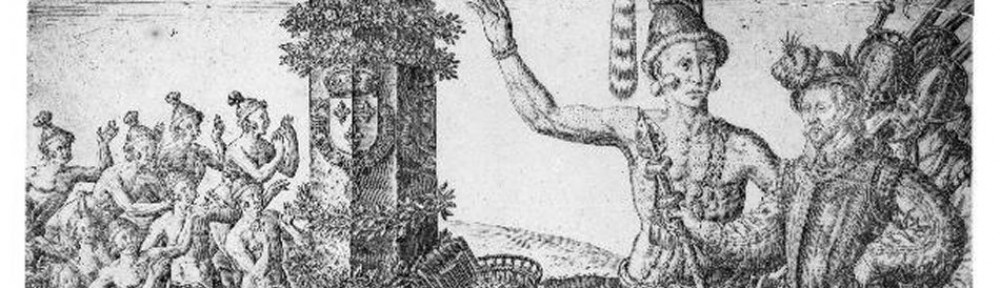
Alonso Gregorio de Escobedo, O.F.M. La Florida [ca. 1590-1610].
DRAFT TRANSLATION. Copyrighted; please do not reproduce without permission. Readers are encouraged to consult a corrected translation in Thomas Hallock (ed.), The Epic of Florida: Selected Poems by Juan de Castellanos, Bartolomé de Flores, and Alonso Gregorio de Escobedo (Penn State UP, 2026).
Canto 28: This canto contains the manner in which the caciques keep the loyalty of and do well for their vassals, how the Indians play the ballgame with their feet, how they bet on foot races of two leagues, and the manner in which they bury their dead.
(344r)
The moring rope that binds the Jarama bull,
and greedy men to their treasures of gold,
and the lazy to their precious bed,
and the monk to his perfect state,
and the doncella to her reputation,
and the bishop to his blessed bishopry,
and the good word of the well born man,
here the shame of being false to one’s word.
Where there was none, I will describe
in detail the infidel town of Florida,
as I promised to the prudent reader,
the rites and customs of their life,
where you will see how diligently those
from enlightened nation of Spain brought
the mercy of God, the sweet sovereign,
the light of clear faith, and Christian law.
(344v)
If God should want the same Mercy for
the Indian, as the worthy Spanish has,
granting the light of Faith, I believe he would live
by our same sanctified Christian law;
for while he wanders blindly without light,
he pacifies by loving his neighbor,
and he freely gives what is asked of him,
and with good words, begs well of others.
There are signs to indicate what I claim,
that he would choose to serve God
with care, even if he is presently
God’s enemy, dying in sin as idolator;
and it is my opinion, I can testify,
that the cacique is respected by all
that he proves with his works, quite clearly,
what I am saying to the wise reader.
Around his house, he sows a field
more than a league wide and long.
From this field comes his own sustenance,
and by those in his house or under his care,
no thief violates what is his possessions,
not a grain is stolen from his fields
until he who is lord and author (autor)
gives license for the town to enter.
(345r)
As Apollo unfurls the warm rays of the sun,
the town cryer sends out a high shout,
“To all people, come gather the maíz,
from the first Indian to the last,
that the cacique, your beloved lord,
consents to share with all, I demand of you,
when I cry out again, grab ye your pitchfork,[21]
from he who gives, come, gather your corn.”
And so the Indians leave their homes,
with great agility, as you would think,
they follow deer trails and well worn paths
to go and reap the grain. Carried from hunger,
they people are delivered from hunger,
they are given good sustenance,
and as this maize serves to survive,
so their their lord gives to them life.
Watch how these villainous rustics eat,
stop, look at them, and consider:
how they take the maize in both hands
and swallow the entire cobs whole.
There is no hound, mastiff nor bulldog,
Nor bear, nor carnivorous lion
that devours so greedily, unchecked,
like skeletons who have lost self-respect.[22]
(345v)
With great rejoicing, with great smiles,
they take, until the second cry sounds,
signaling in their mother tongue, that if
they take any more, they will face great penalites.
They do not leave the corn fields until
a cry is heard, but then, with serene faces,
they go, though each of them to recognize
that the mountain of maize is much smaller sized.
What can be carried, they take home
to eat little by little, although here
I misspeak, for scarcely a cup is left;
these crazy Indians know no moderation,
they lack reason, do not save for leaner times.
What I say impinges their honor,
how these poor men suffer in misery,
because they do not plan more carefully.
For that unfortunate occasion that
tomorrow brings, he will not consider,
as would the more prudent, cautious,
wise, discerning or careful man;
He cares for the present, impertinent,
regardless of what tomorrow will bring;
the varón, who want to live, avoids deprivation
while the Indian often dies of starvation.
(346r)
I am in admiration of the compassion
that burns in the Pagan’s breast.
If brought to the Christian faith,
tt would be a tremendous blessing.
Oh, how many in the lap of the Church
that give alms, but with bitterness.
Here we see, in the cacique, documented
how one gives with the greatest contentment.
But because they lack the true Church,
they are inferior to the Faithful,
and in misery, impoverished, lost,
on par with all who are impoverished.
What an extraordinarily happy turn of luck,
were they to turn from the error of their ways,
and to come to know all-powerful God
and come to follow, these people, his Laws.
They play a ballgame, that if I can give,
a proper account, it would be a pleasure:
Twenty on twenty, on opposing sides,
each with great athleticism and force,
the person carrying the ball stays sharp,
and plays with such poise. There are
no rules on the field, and come evening,
one can see not where the loose ball is going.[23]
(346v)
They skillfully fix a pine tree in the ground,
more than ten estados (fifty feet)[24] in height,
and on the very top of which, with dexterity,
they place a figure in a kind of straw cradle.
All forty of the players take, with great skill,
to the field, where they prove their madness
where, by the rules of this sad game,
they inflict on others unceasing pain.
The game usually last an entire month,
although they return to play everyday.
The one who serves the ball, merrily
tries to move about in various ways,
while his strong opponent move swiftly
to block him with a tackle (porfías),
shoving his hands out in front of him
because his feet does not leave the ground.
While those two go free, as I am saying,
the other thirty eight make war;
each one choosing his enemy and with
strong arms, throwing him to the ground.
If one of them helps his friend
by grabbing the ball in his right hand,
the others complain to the chief,
and he must leave, and never return to, the game.
(347r)
The two valiant squadrons carry on,
fighting as if they were in battle,
subjecting one another to the capture
of their enemy, until the fighting stops.
The armaments of these arrogant Indians,
which are their steel breastplace and finest mail,
are their own formidably strong limbs,
who (on the other side) they want to crush.
While in Castilla they compete with their hands,
the Indians gallantly play with their feet,
with the ball following the right way
of the player with the strongest, quickest feet;
and when the goal is signaled, regardless of time,[25]
fifteen points are made, no argument or complaint;
and then they come to have a hundred,
the game ends, the points are all scored.
The Indian, who by fate finds the ball
in the hands of his posession,
generates such hostility with his play,
people go like blind and crazy men;
on the opposing side, full of malice,
struggling to deprive him of his poise;
his purpose being, thus, to jam
the moves that his opponent plans.
(347v)
The teammates of the player with the ball
battle mightily against their opponents.
The fight, heedless of family,
without respect to brother on brother,
nor father on son, it makes no difference.
One player may try and help, but in vain,
interfering, as the player attacks his opponent,
trying to break up the scrum, and in this way,
he seeks vengeance against his enemy.
If one player slides off to one side,
the opponent darts across and grabs him,
blocking him, in this ballgame, in the same
manner in which the Indians make war;
and as he sees the time running short and (vario?),
the player with the ball in his hand
raises his naked foot from the ground,
hollers the signal for goal from far off.
And when the Indian sounds the signal,
his friends holler shouts of joy;
by hitting the target, valliantly,
their team claims the victory.
The other players, furiously mad,
refuse to lift their eyes all day,
upon seeing that their game was lost,
they feel, in their soul, tremendous loss.
(348r)
Those who play,[26] use what they have
for currency, some fish bones (oserzuelos),
but are valued in Castilla at a filthy cornado[27]
but for them are the principal treasure.
For this scant change, the most renowned
and valorous Indians dance about:
for he who has won receives great graces,
and how is the loser valued? Disgrace.[28]
As the darkness of night begins to fall,
The people split apart, without sanity or law,
trading blows, fighting, with one another,
sometimes they crack open bloody noses.
Others crying, with thousands of pains,
showing the certain, the obvious signs
that they are feeling great discontent,
so great is the pain they hold inside.
They return home, flush with emotion
but empty handed, without gifts,
such is their sad and miserable state,
so being bad and poor people;
some fear for their own death
and cry out, without pause or intervals,
against the pain by which they are oppressed,
that strangles them, which they must suppress.
(348v)
Some of those Indians, miserable are they are,
seek to prove their fame on occasion and
will by their own choice and pleasure,
imitate those brave cimarrones, the Timucuan,
whose courage and spirit they use in their play
with clubs (macanas), or to say heavy sticks,
so that, when an enemy should come about,
he is not ignorant of the way out.
Others shoot arrows at their mark,
and hitting their target at one hundred paces,
they give such a great shout and cry,
that it carries across the brisk breeze.
They show contentedness, joy and pleasure
on seeing an opponent (traidor) to their touch,
because if the Spaniards make themselves merry
they lose their force, or if not, recover it.
Some fight each other, chest to chest,
to demonstrate their fortitude and strength,
so much do the Indians esteem their own strength.
and speak very highly of his own skills,
If the strength of a soldier is worthy,
the Indian will brag about those vile deeds
but in the point that reason sends him,
his life he will take, from the demand.
(349r)
Others, with great force in their arms,
throw great pieces of iron (barra) stones;
others rip apart the knot in a pine tree
to see who can tear their way to the center;
others, with no regrets or obstacles,
climb the shoots of a grape vine;
others spear birds in mid-flight,
and later, eat these birds with delight.
Others run a distance of two leagues
without stopping in fields nor in plains,
and while the victory brings little gain,
less than a real for each run;
it is plenty, what they gain in bragging rights,
the members of this valiant, sinful and fierce nation:
a wonderful crown of palms and laurels
is won, and placed upon the winner’s head.
The poor Indian runners come,
covered in sweat, and they cry out,
in a thousand shouts and cries, as the
fatigue presses them, showing in their faces.
Their bodies are racked by a thousand pains;
to reach the end, they had prepared themselves
with a remedy that they use, but are lucky,
because this remedy could cause their death.
(349v)
And while it would seem to be bad for them,
the runners are kept healthy in this manner,
how they ordinarily care for them
would typically kill their runners;
this extraordinary (potísimo) remedy
is what the runner appears to wait for,
although it strikes me to be one
that the whole world would laugh at it.
The women wait right until
their gallent hero’s return, then they
drench the sweating athlete in water,
the water cooling the runner’s passions.
The women do this, showering the runner,
who wears a white shirt and lies on his mattress,
and here they remain, bold and content,
valient, undaunted, and strong.
And when the sweat has been washed off,
the fleet Indian takes on a new wager:
he will run with the most agile warrior,
even thought is it the middle of siesta.
He is given sea water,
brisk, invigorating and strong —
the winner make merry with his children and wife,
finding contentment, always, in his skill.
(350r)
If the principle cacique comes to their home,
a cacique with great fame and tribute,
some Indians will seek out the dainty nuts[29]
the same used to fatten a bristly and suckling pig.
and make gacha, a prized dish
that they can serve without shame;
they make it beforehand, so they have some
to feed the cacique when he comes.
They make great quantities of the dish,
which is not only small but bitter,
they gather up acorns (bellota),
carefully removing the bitter shells;
although they grind the acorns for a long time,
the labor does not bother them,
they eat this dish with great gusto.
They make a hillock (sepultura) for
the ground acorns, burying them while
the most ardent rays of the lovely sun
come from the East, at about noon,
and because the coldness damages them,
they simmer the dish in hot water;
it is cooked this way, in the soil,
that the torta de gacha comes out whole.
(350v)
The soil and water give a flavor
to the acorns (fruta) to which I refer,
so they eat with no small relish (sin disgusto);
the principal caciques of Florida sends
some to the most strong and robust laborers,
typically giving them some to eat,
because this gacha, dedicated to the chief,
is by all Indians most highly esteemed.
The principle Indian is so poised
that one will never, ever see him
eat too much, or with mouth open,
like the more gluttunous will eat;
even as hunger has fatigued him,
discretion keeps his passions in check;
he gives no signs of showing weakness
but shows how he is strong and courteous.
Other Indians walk for ten days,
carrying only toasted corn flour,
crossing high and remote mountains
with a steady and speedy step,
only to bring back valuable leaves
from the tree, as I have said,
which is called cacina in the West,
brewed and valued by all as the best..
(351r)
Far more than the finest gold
do they value this precious little tree;
the principle chief, the nobility,
brew it in their homes always,
and they drink it, with relish, like wine
because the tea has a marvelous flavor
and gives strength to those without vigor
even when they are weakened by hunger.
Also, they make with the ashes
a very tasty corn dish, gachuela,
which they leave out until midday,
for all to eat who come to their home.
There the brave fighters before disputes,
these attentive, vile rustic townspeople
they go the food that has been prepared;
against their vile enemies, off to make war.
And the moment they enter the house,
they sound a horrible, ferocious yell,
that pierces all the senses, so that
no one dares look upon them,
but without delay or skimpy hand;
they help themselves and do not rest
until they have taken in the middle
of the house this smooth, valued dish.
(351v)
Eating the gacha, shellfish and good fish,
the brave soldiers satisfy their hunger,
tribute is always made from the heart
in rations, to which soldiers are due.
It is an ancient, age-old rite
to give sustenance to those Indians
among them, who are leaving for battle,
against our own, who are wearing mail.
These valiant soldiers wear the scalps[30]
of the Spaniards whom they have stripped of life;
the heads of the honorable Christians
hang from their legs as from a garter.
They are the Guale Indians, a ferocious nation,
unlike others that have been seen in Florida,
they are different: their faces are lined
with tattoos, showing their ferocity and force.
Those most fortunate, the most valient,
whose faces are etched with designs,
parade through the plaza with all
people present, to have respects paid;
and those who wear their garters amongst
these people are the most celebrated,
the most courageous race in their land;
they are chosen to war against Spain.
(352r)
When the Indian is asked, “tell me, poor soul,
why do you not want to become a Christian?”
The poor ponentino (westerner) responds:
“Because the devil smacks me with his hand,
and says to me, “traitor, miserable whelp,
do not believe what the Castilian says.
Accept my deceptions, because if you do,
great favors, if you believe, will come to you.”
And when some of them were baptized,
and as they tore off their vestments,
they returned to their corrupted rituals,
leaving what brings glory and peace,
And if someone says: “Damned souls,
why not use your gift of reason —
and why not forget Jesus, sweet Lord,
and love instead the tyrant Lucifer?”
They respond as such: “if we accepted
the law of God, the cause was the clothes.
But later, señor, we tore off the clothes,
putting your rites out of our heads.
We returned to our old ways, finding
contentment in what we were born with,
and we stopped cutting our hair.”
Indian customs, so evil and fierce!
(352v)
Upon dying, passing from this life,
the Indians are placed in a sepulchre cave,
and in that cave, they leave food,
so their dead may have plenty.
Being so united with the devil,
death takes an even uglier form:
these barbarians are absolutely certain
that the dead sinner still feels hunger.
The possessions of the deceased
are buried in a deep cave with him.
No one would dare touch his things,
instead all pay respects to the grave.
They mourn, they mark the death,
in the coutryside, mountain, fields and plains,
where tears are shed for the poor decased,
without missing even a single day.
Each morning for an entire year,
they cry to the sinful ponentino,
and as a custom, as their ritual and rite,
they cover themselves with ashes continually.
The Devil, being a great teller of tales,
whispers words sweet on the surface,
enters into the cadaver and consoles them,
revealing four thousand lies to them.
(353r)
And the laments stop when mourning finishes,
and by choice, they return to their homes,
and they grind the corn for sustenance
that was toasted over the coals,
and they eat gladly, with the ashes,
or by another recipe, the women mix
the dough with warm water to feed them,
which like our bread, gives sustenance.
And it gives great strength and vigor
to those who eat it, as I have said,
that the pure white bread made from dough
by the woman who are friendly to our side,
although the method always straightens up
the health of the cruel enemy,
by bringing so much blood to the human body,
that thousands of tumors born by summer.
In particular, the bread does harm to
our Spanish people, who are used to
eating wheat bread that has been leavened,
although there is great poverty at home.
But if one is in need, his hands are tied,
he will eat the Indian bread in a pinch,
although he will not devour such food
but eat only so his body will survive.[31]
(353v)
After a while, one will feel sick and
weighted down from eating this heavy bread.
It is such bitter and disgusting food,
making anyone who eats it angry.
If a person does not lighten his veins,
the blood in his body will raise up,
suffering such damage to this health,
that death will come by this instrument.
I promised the previous day to provide
an account of a certain war that
the true and valient Spaniards waged
against the French who came to their country,
who came to Florida with such insolence,
intending to be thieves, as from my quill
in another canto, recounted here still.[32]
[1] gentil: “The idolator that had no knowledge of a true God, and worshipped false idols” (Sebastían de Covarrubias Horozco, Tesoro de la lengua castellano o española, 1611).
[2] homicida: a favorite end rhyme for Escobedo, implying spiritual death. Covarubbias quotes John 8:44, “Ille homicida erat ab initio ….”
[3] Hechizar: Use image, “hombre hechizado,” from “Hechizar” in Covarrubias.
[4] provincias de la gran Florida: by “provincias” Escobedo would mean “colony,” and by la gran Florida a tremendous expanse, stretching from Key West as far as (by some maps) Nova Scotia.
[5] “si manifiesta de unos ser contrario / a otros de favor en esta vida”.
[6] “Poniente“: “The part of the the sky from where the sun darkens in the other hemisphere, beyond the horizon … another part of the world” (Covarrubias); Escobedo means tose from the far side of a sunset, or “westerners.” With the usage, a favorite of his, Escobedo also anticipates the following homily from Matthew 20:16, “he who is first shall later be last. ”
[7] “Si como tienen obras fe tuvieran / fueran de lost llamados y escogidos ….”
[8] tercia: the third part of the day in canonical hours, between the sixth hour (sesta, midday) and the ninth (nons) hour, or 3:00 pm.
[9] “pavo real“: turkey, as illustrated by Covarrubias, although the real following pavo also puns on the Spanish currency (un real). The discussion of the turkey, or “montesino” (thing of the woods) continues in the next stanza.
[10] Again, Escobedo puns on “homicida”: “ … pues al segundo salto de la vida / al indio cazador que es su homicida”.
[11] gamuza: “a type of mountain goat … whose skin is tanned to make breeches and “jubones” (vest?) (Covarrubías).
[12] gran: “great,” by common usage, but possibly ironic. Covarrubías defines “grande” as not only the “opposite of small” but a “title of great honor.”
[13] boniatos: note on sweet potatos?
[14] corvinatas: perhaps sea bass; Falcones has mullet.
[15] Following Escobedo’s concession, Sununu includes corroborating accounts by Nicolás Monardes Alfaro, Historia medicinal de las cosas que se traen de nuestras Indias Occidentales (1565) and from José de Acosta, Historia natural y oral de las Indias (1590). Covington and Falcones speculate that the Indians wrestled pilot whales or (less plausibly) manatees (153n).
[16] “Y es tenida de todos por tan buena ….”
[17] In a long discussion of the subject, Covarrubías also asserts the belief that ambar, a “paste with extremely smooth odor,” was made from the “excrement” of a whale.
[18] Escobedo puns, in line 8, on “indigno” to also suggest “Indio.”
[19] On the availability of food, Escobedo contradicts other stanzas (Sununu 2:896n).
[20] Probably the coast of Fort Myers (Sununu 897n).
[21] “porné en la horca”: porné being an antiquated form of pondré, or take.
[22] Sununu has “porque a razón perdieron el respeto”; the manuscript, she notes, reads “arrazón” (2:903 taken here for “armazón,” or skeleton.
[23] “ … su pelota va siendo arrojada”: more literally, the ball goes about unpredictably and with force.
[24] Estado: measuring roughly the height of one man (Covarrubias).
[25] “dando en la señal, tarde o temprano.”
[26] “Los que juegan”: perhaps, “those who gamble on the game?”
[27] Cornado: fifteenth century coin, valued at one tenth of a maravedí; Covington and Falcones have “copper coin” (149).
[28]In the stanzas closing couplet, , Escobedo uses his favorite tropes of chiasmus and repetition: ” … por ganar, que quien gana, gana honra, / y gana el que perdió, suma deshonra.
[29] frutilla: probably acorns, although Sununu defines gacha (below) as a dish made from corn and honey, or what would be like the traditional softee.
[30] “Estos valientes traen la caballera / que al español quitaron con la vida ….”: Covington and Falcones translate this stanza to “These men wear on their legs, as if they were garters, the hear from some Spaniard who they have killed (151).
[31] Escobedo puns again on a favorite word, “homicidia”: que no va largando a tal comida, / por no ser de su cuerop el homicidia” (2:923) .